
The Engineering Record
Software whose numbers end up in a report is built on paper as much as on code: requirements, verification dossiers, a hazard analysis, an architecture, a security position. This is the register of that paper. What exists, what number and version it carries, and where each document stands.
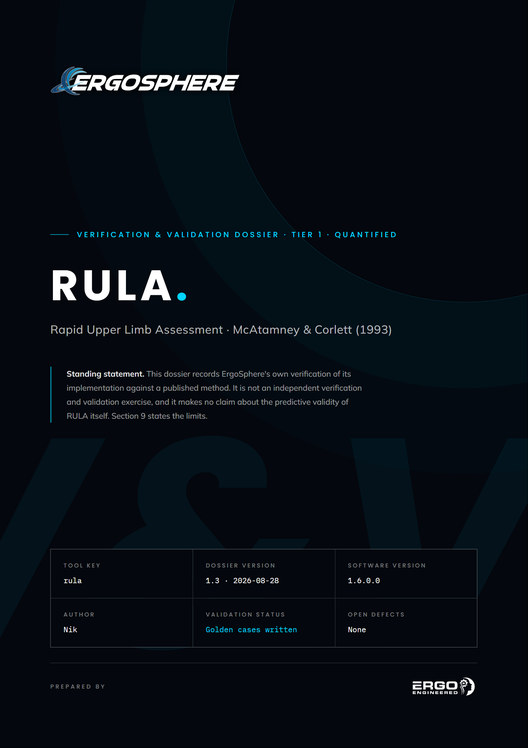 ES-VV-002v1.5
V&V Dossier
RULA
Rapid Upper Limb Assessment
Released under NDA
ES-VV-001v1.4
V&V Dossier
REBA
Rapid Entire Body Assessment
Released under NDA
ES-VV-003v1.5
V&V Dossier
NASA-TLX
NASA Task Load Index
Released under NDA
ES-VV-004v1.4
V&V Dossier
NIOSH
Revised NIOSH Lifting Equation
Released under NDA
ES-VV-005v1.4
V&V Dossier
ART
Assessment of Repetitive Tasks
Released under NDA
ES-VV-006v1.4
V&V Dossier
MAC
Manual Handling Assessment Charts
Released under NDA
ES-VV-007v1.4
V&V Dossier
RAPP
Risk Assessment of Pushing and Pulling
Released under NDA
ES-VV-008v1.1
V&V Dossier · Tier 3
ErgoLens
Measurement chain feeding RULA and REBA
Released under NDA
ES-VV-009v1.1
V&V Dossier · Tier 3
ErgoSense
Measurement chain feeding RULA, REBA and NIOSH
Released under NDA
ES-VV-010v1.3
V&V Dossier · Tier 1
Snook
Liberty Mutual manual materials handling tables
Released under NDA
ES-VV-011v1.4
V&V Dossier · Tier 1
THERP
Technique for Human Error Rate Prediction
Released under NDA
ES-VV-012v1.0
V&V Dossier · Tier 1
CREAM
Cognitive Reliability and Error Analysis Method
Released under NDA
ES-VV-013v1.2
V&V Dossier · Tier 1
HEART
Human Error Assessment and Reduction Technique
Released under NDA
ES-VV-014v1.0
V&V Dossier · Tier 1
SPAR-H
Standardized Plant Analysis Risk, Human Reliability Analysis
Released under NDA
ES-VV-015v1.2
V&V Dossier · Tier 1
SLIM
Success Likelihood Index Methodology
Released under NDA
ES-VV-016v1.3
V&V Dossier · Tier 2
SCTA
Safety Critical Task Analysis
Released under NDA
ES-VV-017v1.4
V&V Dossier · Tier 2
SHERPA
Systematic Human Error Reduction and Prediction Approach
Released under NDA
ES-VV-002v1.5
V&V Dossier
RULA
Rapid Upper Limb Assessment
Released under NDA
ES-VV-001v1.4
V&V Dossier
REBA
Rapid Entire Body Assessment
Released under NDA
ES-VV-003v1.5
V&V Dossier
NASA-TLX
NASA Task Load Index
Released under NDA
ES-VV-004v1.4
V&V Dossier
NIOSH
Revised NIOSH Lifting Equation
Released under NDA
ES-VV-005v1.4
V&V Dossier
ART
Assessment of Repetitive Tasks
Released under NDA
ES-VV-006v1.4
V&V Dossier
MAC
Manual Handling Assessment Charts
Released under NDA
ES-VV-007v1.4
V&V Dossier
RAPP
Risk Assessment of Pushing and Pulling
Released under NDA
ES-VV-008v1.1
V&V Dossier · Tier 3
ErgoLens
Measurement chain feeding RULA and REBA
Released under NDA
ES-VV-009v1.1
V&V Dossier · Tier 3
ErgoSense
Measurement chain feeding RULA, REBA and NIOSH
Released under NDA
ES-VV-010v1.3
V&V Dossier · Tier 1
Snook
Liberty Mutual manual materials handling tables
Released under NDA
ES-VV-011v1.4
V&V Dossier · Tier 1
THERP
Technique for Human Error Rate Prediction
Released under NDA
ES-VV-012v1.0
V&V Dossier · Tier 1
CREAM
Cognitive Reliability and Error Analysis Method
Released under NDA
ES-VV-013v1.2
V&V Dossier · Tier 1
HEART
Human Error Assessment and Reduction Technique
Released under NDA
ES-VV-014v1.0
V&V Dossier · Tier 1
SPAR-H
Standardized Plant Analysis Risk, Human Reliability Analysis
Released under NDA
ES-VV-015v1.2
V&V Dossier · Tier 1
SLIM
Success Likelihood Index Methodology
Released under NDA
ES-VV-016v1.3
V&V Dossier · Tier 2
SCTA
Safety Critical Task Analysis
Released under NDA
ES-VV-017v1.4
V&V Dossier · Tier 2
SHERPA
Systematic Human Error Reduction and Prediction Approach
Released under NDA
V&V dossiers ES-VV 43 on file · 17 shown
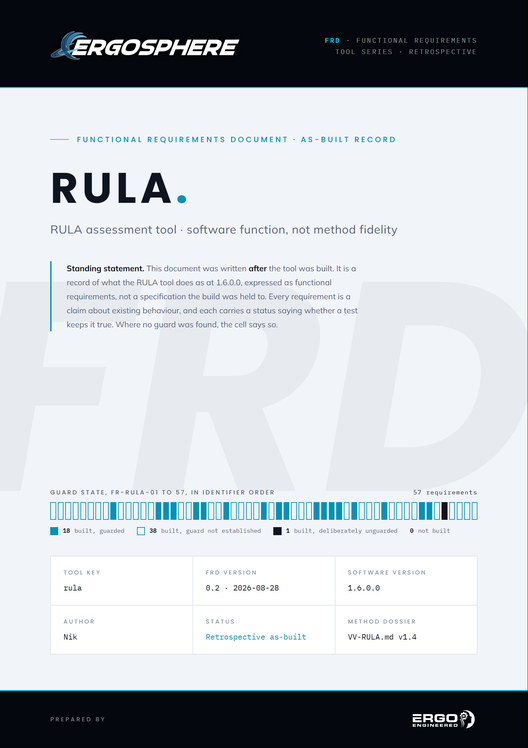 ES-FRD-002v0.5
Requirements
RULA Tool
Retrospective as-built record of the shipped tool
Released under NDA
ES-FRD-002v0.5
Requirements
RULA Tool
Retrospective as-built record of the shipped tool
Released under NDA
Functional requirements ES-FRD 13 on file · 1 shown
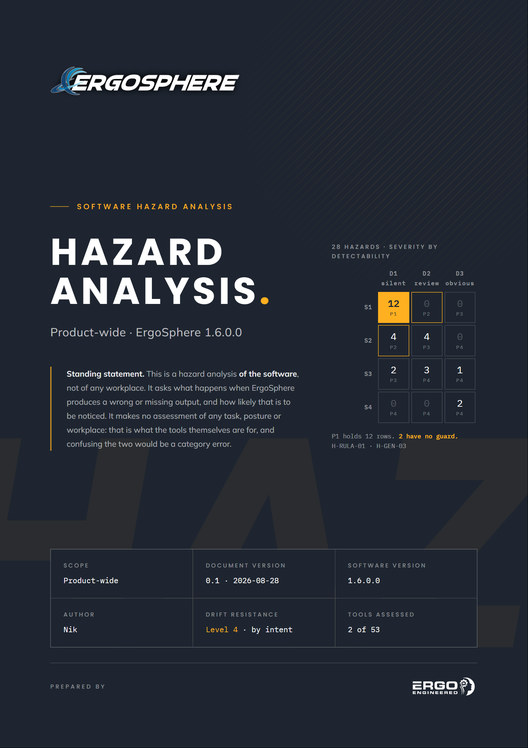 ES-HAZ-000v0.2
Hazard Analysis
Software Hazard Analysis
One severity scale, rows added per tool
Released under NDA
ES-HAZ-000v0.2
Hazard Analysis
Software Hazard Analysis
One severity scale, rows added per tool
Released under NDA
Hazard analysis ES-HAZ 1 on file
Security ES-SEC 1 on file
Architecture ES-ARC 1 on file
The Paper Behind The Numbers
ErgoSphere is a library of published assessment methods, implemented as one desktop application. Each method is verified against the source that defined it, each tool is described as a set of functional requirements, and the whole product carries a hazard analysis, a security whitepaper and an architecture. Those documents are controlled: numbered, versioned, dated, and tied to the software build they describe.
The documents themselves are released on request under NDA, because the working inside them describes how the software is built as much as how it was checked. What this page publishes is the register: the fact that each document exists, the number and version it carries, and the rung it stands on. Nothing here is a forecast. A row changes when a document does.
How a method earns its dossier, and what the eight components are, is described on the Dossier Project page. This page is the inventory that programme produces.
Formalised, and Made Public
What is new here is the formalisation and the publication, not the work. ErgoSphere shipped 1.6.0.0 with a suite of nearly eight thousand test methods, written alongside the tools over the life of the build, and 1.6.1.0 carries more than eleven thousand. The lookup tables, band edges and boundary rules those tests assert are the same ones the dossiers now cite.
The architecture document and the security whitepaper were written months earlier and had reached their third and second versions before this register existed. Drafts of much of the rest had been sitting in a working folder.
What The Dossier Project did was formalise all of it - number each document, version it, tie it to the build it describes - and then publish the register. None of that changes what the software does. It changes who is able to check it.
Formalising is not rubber-stamping, and this register would be worth little if it were. Reading a test against the publication it claims to implement is a different act from writing that test, and doing it has turned up real defects: tests that asserted, in the affirmative, that the software agreed with itself; a band grouping that disagreed with its own source at two ratings, both times optimistically; a method guide printing a severity scale that contradicted the numbers in the report two pages later. Each one is fixed, guarded by a named test, and written into the dossier it belongs to.
The documents say this about themselves where it counts. Every functional requirements document, from ES-FRD-002 onward, opens by stating it is a retrospective as-built record, drafted from the shipped code rather than written ahead of it, and every requirement in it carries whether a test keeps it true.
- ES-ARC-000 · v1.3
The system architecture, written months before this register and already at its third version when it was numbered.
- ES-SEC-000 · v1.2
The security whitepaper, on the same footing. Both were brought under document control and numbered on 2026-08-30.
- 1.6.1.0
11,162 test methods, counted 2026-09-07. The suite run of 2026-09-06 executed 14,706 test cases, because a theory with twenty rows runs twenty times. The Dossier Project audits that suite, and what it raises is recorded against the method it belongs to.
- 2026-08-30
The whole dossier moved into the source repository. Evidence for a version now branches, tags and ships with the code it makes claims about.
How to Read a Number
ErgoSphere. Every controlled document in the product starts here.
Which kind of document it is. Five series: VV, FRD, HAZ, SEC, ARC.
Three blocks. 000 is product-wide. 001 to 099 is a method's place in the programme. 100 and up is a capability's: a module of the product that is software rather than a published method. An index is shared across series, so ES-VV-002 and ES-FRD-002 are both RULA.
The document's own version, separate from the number. A number never changes; a version moves every time the document is re-issued. Dossiers issue at 1.0. A functional requirements document issues below 1.0 and climbs as its requirements are confirmed against tests.
000Product-wide
One document that covers the whole product. The hazard analysis, the security whitepaper and the architecture each carry it, one per series.
001 to 099A method
Assigned once, in the order the method entered the programme, and never reused. REBA is 001 and RULA is 002 in every series they appear in.
100 +A capability
A module of the product with no published method behind it, verified as software against the standards it ingests. The compliance and assurance module is 100.
How to read a row
The document's permanent identity. Quote it when requesting the document.
The method, tool or subject, and for a dossier its tier, which sets what kind of evidence the dossier can carry.
The version on the document's own title block and the date that version was issued. Both are read from the document, never from this page.
The ErgoSphere release the document was written against. A later release does not move a row on its own, only a re-issued document does.
The rung the document stands on, and under it the stage: where the work has reached, in the register's own words. The rungs and stages are set out under the register.
ES-VVVerification and validation dossier
One per method. Answers one question: does the software implement the published method faithfully? Provenance, implementation specification, golden cases, boundary behaviour, known deviations, limits of validation, and one section only an outside reviewer can sign.
ES-FRDFunctional requirements
One per tool. What the tool is required to do as software: document lifecycle, guided entry, persistence, reporting. Restates nothing from the dossier; where a number appears in both, the dossier is the one that is right.
ES-HAZSoftware hazard analysis
Product-wide. What happens when the software produces a wrong or missing output, and how likely that is to be noticed. It is a hazard analysis of the software, not of any workplace, and its only job is to order the test queue by consequence.
ES-SECSecurity whitepaper
Product-wide. How the application handles data and what it does not do: no cloud account, no server, all work local. The security position, stated so it can be checked.
ES-ARCSystem architecture
Product-wide. How the system is put together: one task decomposition feeding every method, the registers that hold findings, and the sealed deliverable that leaves the building. The document the other four are read against.
Every Document On File
59 documents · 5 series · 0 independently verified
V&V dossiers ES-VV · 43
| Number | Document | Version | Issued | Describes | Status |
|---|---|---|---|---|---|
| ES-VV-001 | REBARapid Entire Body Assessment · Tier 1 | 1.4 | 2026-08-27 | 1.6.0.0 | In progressGolden cases written |
| ES-VV-002 | RULARapid Upper Limb Assessment · Tier 1 | 1.5 | 2026-08-28 | 1.6.0.0 | In progressGolden cases written |
| ES-VV-003 | NASA-TLXNASA Task Load Index · Tier 1 | 1.5 | 2026-08-27 | 1.6.0.0 | In progressGolden cases written |
| ES-VV-004 | NIOSHRevised NIOSH Lifting Equation · Tier 1 | 1.4 | 2026-09-06 | 1.6.0.0 | In progressGolden cases written |
| ES-VV-005 | ARTAssessment of Repetitive Tasks of the upper limbs · Tier 1 | 1.4 | 2026-09-06 | 1.6.0.0 | In progressGolden cases written |
| ES-VV-006 | MACManual Handling Assessment Charts · Tier 1 | 1.4 | 2026-08-28 | 1.6.0.0 | In progressGolden cases written |
| ES-VV-007 | RAPPRisk Assessment of Pushing and Pulling · Tier 1 | 1.4 | 2026-08-28 | 1.6.0.0 | In progressGolden cases written |
| ES-VV-008 | ErgoLensCamera pose measurement chain feeding RULA and REBA · Tier 3 | 1.1 | 2026-08-28 | 1.6.0.0 | In progressSources held |
| ES-VV-009 | ErgoSenseInertial suit measurement chain feeding RULA, REBA and NIOSH · Tier 3 | 1.1 | 2026-08-28 | 1.6.0.0 | In progressSources held |
| ES-VV-010 | Snook and CirielloLiberty Mutual manual materials handling tables · Tier 1 | 1.3 | 2026-09-07 | 1.6.0.0 | In progressGolden cases written |
| ES-VV-011 | THERPTechnique for Human Error Rate Prediction · Tier 1 | 1.4 | 2026-09-07 | 1.6.0.0 | In progressGolden cases written |
| ES-VV-012 | CREAMCognitive Reliability and Error Analysis Method · Tier 1 | 1.0 | 2026-08-29 | 1.6.0.0 | In progressGolden cases written |
| ES-VV-013 | HEARTHuman Error Assessment and Reduction Technique · Tier 1 | 1.2 | 2026-08-29 | 1.6.0.0 | In progressGolden cases written |
| ES-VV-014 | SPAR-HStandardized Plant Analysis Risk, Human Reliability Analysis · Tier 1 | 1.0 | 2026-08-29 | 1.6.0.0 | In progressGolden cases written |
| ES-VV-015 | SLIMSuccess Likelihood Index Methodology · Tier 1 | 1.2 | 2026-09-07 | 1.6.0.0 | In progressGolden cases written |
| ES-VV-016 | SCTASafety Critical Task Analysis · Tier 2 | 1.3 | 2026-08-29 | 1.6.0.0 | In progressProcess conformance walked |
| ES-VV-017 | SHERPASystematic Human Error Reduction and Prediction Approach · Tier 2 | 1.4 | 2026-08-29 | 1.6.0.0 | In progressProcess conformance walked |
| ES-VV-018 | SWATSubjective Workload Assessment Technique · Tier 1 | 1.1 | 2026-08-29 | 1.6.0.0 | In progressGolden cases written |
| ES-VV-019 | TRACErRetrospective and predictive Analysis of Cognitive Errors · Tier 2 | 1.1 | 2026-08-29 | 1.6.0.0 | In progressProcess conformance walked |
| ES-VV-020 | GDTAGoal-Directed Task Analysis · Tier 2 | 1.0 | 2026-08-30 | 1.6.0.0 | In progressProcess conformance walked |
| ES-VV-021 | SAGATSituation Awareness Global Assessment Technique · Tier 2 | 1.0 | 2026-08-30 | 1.6.0.0 | In progressProcess conformance walked |
| ES-VV-022 | DRTDetection-Response Task · Tier 2 | 1.0 | 2026-08-30 | 1.6.0.0 | In progressProcess conformance walked |
| ES-VV-023 | IWSIntegrated Workload Scale · Tier 2 | 1.1 | 2026-08-31 | 1.6.0.0 | In progressProcess conformance walked |
| ES-VV-024 | uFMEAuse Failure Mode and Effects Analysis · Tier 1 | 1.2 | 2026-09-06 | 1.6.0.0 | In progressGolden cases written |
| ES-VV-025 | URRAUse-Related Risk Analysis · Tier 2 | 1.0 | 2026-08-30 | 1.6.0.0 | In progressProcess conformance walked |
| ES-VV-026 | ATWITAir Traffic Workload Input Technique · Tier 2 | 1.2 | 2026-08-31 | 1.6.0.0 | In progressProcess conformance walked |
| ES-VV-027 | SNASocial Network Analysis · Tier 1 | 1.1 | 2026-08-31 | 1.6.0.0 | In progressGolden cases written |
| ES-VV-028 | EASTEvent Analysis of Systemic Teamwork · Tier 1 | 1.2 | 2026-08-31 | 1.6.0.0 | In progressGolden cases written |
| ES-VV-029 | HE-HAZOPHuman Error HAZOP · Tier 2 | 1.5 | 2026-09-01 | 1.6.0.0 | In progressProcess conformance walked |
| ES-VV-030 | ErgoGlareSolar Glare Hazard Analysis Tool, SGHAT · Tier 1 | 1.1 | 2026-09-01 | 1.6.0.0 | In progressSources held |
| ES-VV-031 | HTAHierarchical Task Analysis · Tier 2 | 1.4 | 2026-09-02 | 1.6.0.0 | In progressSources held |
| ES-VV-032 | ErgoRadarHolistic assessment framework of Stroeve, Kirwan and Everdij · Tier 2 | 1.5 | 2026-09-02 | 1.6.0.0 | In progressProcess conformance walked |
| ES-VV-033 | SARTSituational Awareness Rating Technique · Tier 1 | 1.1 | 2026-09-02 | 1.6.0.0 | In progressSources held |
| ES-VV-034 | GOMSGoals, Operators, Methods and Selection Rules · Tier 1 | 1.4 | 2026-09-02 | 1.6.0.0 | In progressGolden cases written |
| ES-VV-035 | CDMCritical Decision Method · Tier 2 | 1.1 | 2026-09-02 | 1.6.0.0 | In progressSources held |
| ES-VV-036 | NielsenHeuristic evaluation · Tier 2 | 1.1 | 2026-09-02 | 1.6.0.0 | In progressSources held |
| ES-VV-037 | AcciMapAccident mapping across socio-technical levels · Tier 2 | 1.2 | 2026-09-02 | 1.6.0.0 | In progressSources held |
| ES-VV-038 | ErgoActACT-R cognitive architecture · Tier 1 | 1.3 | 2026-09-02 | 1.6.0.0 | In progressSources held |
| ES-VV-039 | ErgoTraceSTAMP: STPA and CAST · Tier 2 | 1.1 | 2026-09-06 | 1.6.1.0 | In progressSources held |
| ES-VV-040 | SUSSystem Usability Scale · Tier 1 | 1.1 | 2026-09-06 | 1.6.1.0 | In progressSources held |
| ES-VV-041 | ErgoCompassBinary-Based Model method selection · Tier 1 | 1.1 | 2026-09-06 | 1.6.1.0 | In progressSources held |
| ES-VV-042 | ErgoAIRAlarm identification and rationalisation, ANSI/ISA-18.2 · Tier 1 | 1.1 | 2026-09-06 | 1.6.1.0 | In progressSources held |
| ES-VV-100 | Compliance and assurance capabilityCompliance engine and human factors assurance process · Tier 2 | 1.16 | 2026-09-01 | 1.6.0.0 | In progressSources held |
Functional requirements ES-FRD · 13
| Number | Document | Version | Issued | Describes | Status |
|---|---|---|---|---|---|
| ES-FRD-002 | RULA toolFunctional requirements, retrospective as-built record | 0.5 | 2026-08-28 | 1.6.0.0 | In progressRetrospective as-built record of the shipped tool, each requirement carrying its test status |
| ES-FRD-004 | NIOSH toolFunctional requirements, retrospective as-built record | 0.2 | 2026-09-06 | 1.6.1.0 | In progressRetrospective as-built record of the shipped tool, each requirement carrying its test status |
| ES-FRD-005 | ART toolFunctional requirements, retrospective as-built record | 0.2 | 2026-09-06 | 1.6.1.0 | In progressRetrospective as-built record of the shipped tool, each requirement carrying its test status |
| ES-FRD-006 | MAC toolFunctional requirements, retrospective as-built record | 0.2 | 2026-09-06 | 1.6.1.0 | In progressRetrospective as-built record of the shipped tool, each requirement carrying its test status |
| ES-FRD-007 | RAPP toolFunctional requirements, retrospective as-built record | 0.2 | 2026-09-06 | 1.6.1.0 | In progressRetrospective as-built record of the shipped tool, each requirement carrying its test status |
| ES-FRD-010 | Snook toolFunctional requirements, retrospective as-built record | 0.2 | 2026-09-07 | 1.6.1.0 | In progressRetrospective as-built record of the shipped tool, each requirement carrying its test status |
| ES-FRD-011 | THERP toolFunctional requirements, retrospective as-built record | 0.2 | 2026-09-07 | 1.6.1.0 | In progressRetrospective as-built record of the shipped tool, each requirement carrying its test status |
| ES-FRD-013 | HEART toolFunctional requirements, retrospective as-built record | 0.2 | 2026-09-06 | 1.6.1.0 | In progressRetrospective as-built record of the shipped tool, each requirement carrying its test status |
| ES-FRD-015 | SLIM toolFunctional requirements, retrospective as-built record | 0.2 | 2026-09-07 | 1.6.1.0 | In progressRetrospective as-built record of the shipped tool, each requirement carrying its test status |
| ES-FRD-024 | uFMEA toolFunctional requirements, retrospective as-built record | 0.2 | 2026-09-06 | 1.6.1.0 | In progressRetrospective as-built record of the shipped tool, each requirement carrying its test status |
| ES-FRD-032 | ErgoRadar toolFunctional requirements, retrospective as-built record | 0.4 | 2026-09-06 | 1.6.1.0 | In progressRetrospective as-built record of the shipped tool, each requirement carrying its test status |
| ES-FRD-034 | GOMS toolFunctional requirements, retrospective as-built record | 0.4 | 2026-09-06 | 1.6.1.0 | In progressRetrospective as-built record of the shipped tool, each requirement carrying its test status |
| ES-FRD-100 | Compliance and assurance capabilityFunctional requirements, retrospective as-built record | 0.7 | 2026-09-01 | 1.6.0.0 | In progressRetrospective as-built record of the shipped tool, each requirement carrying its test status |
Hazard analysis ES-HAZ · 1
| Number | Document | Version | Issued | Describes | Status |
|---|---|---|---|---|---|
| ES-HAZ-000 | Software Hazard AnalysisProduct-wide, rows added per tool | 0.2 | 2026-08-28 | 1.6.0.0 | In progressRegister guarded in the test suite, level 2 |
Security & privacy ES-SEC · 1
| Number | Document | Version | Issued | Describes | Status |
|---|---|---|---|---|---|
| ES-SEC-000 | Security and Data Privacy WhitepaperProduct-wide | 1.2 | 2026-08-30 | N/A | CompletedProduct-wide, not on the verification ladder |
Architecture ES-ARC · 1
| Number | Document | Version | Issued | Describes | Status |
|---|---|---|---|---|---|
| ES-ARC-000 | System Architecture DocumentProduct-wide | 1.3 | 2026-08-30 | N/A | CompletedProduct-wide, not on the verification ladder |
- In progress
The document exists and is issued, and sections remain open. Every dossier sits here until its internal review is signed.
- Internally verified
Complete to its template and signed by ErgoSphere's internal review. This is as far as anyone inside the company can move a document.
- Independently verified
Signed by a competent person outside ErgoSphere. No amount of internal work reaches this rung, which is what gives the other two their meaning. Where that reviewer accepted a licence under the Verification Cohort, it is recorded as a declared interest in the dossier's section 8.1 and released with the document every time.
Tier 1Quantified
The source publishes values: lookup tables, constants, or a worked example with an answer. Its arithmetic can be reproduced, so the dossier carries golden cases encoded from the publication.
Tier 2Descriptive
The source publishes a procedure, not a scored example. There is no number to reproduce, so a process conformance walk stands in and the golden-case row reads n/a. That means the row cannot move, not that the work was skipped.
Tier 3Measurement chain
Implements no published method at all. ErgoLens and ErgoSense are sensing pipelines feeding RULA, REBA and NIOSH. The evidence that counts here is observer parity, and we do not hold it yet, which is why both read Sources held.
Completed sits outside those three rather than above them. The product-wide security and architecture documents carry no review sections and no independent signature to collect, so there is no rung for them to climb. It says the document is finished, not that anyone has checked it.
Requesting a Document
Any document in the register is released on request, under NDA, to the customers, auditors and reviewers who need to verify what they rely on. Quote the number. If you are assessing ErgoSphere for work that has to stand up, ask about the document you actually care about and we will tell you where it stands and what it does not yet cover.
To request a document by number, or to ask where one stands, write to us.
The Rung We Cannot Reach
We are a small firm. The methods are not ours - they belong to the people who published them and to the profession that uses them - and we are not in a position to have a laboratory check our arithmetic. So we are asking the people who would notice. If you use RULA in your work you already know where it bites, and an afternoon of that against a dossier is worth more than a procurement exercise.
It is also the only way the top rung on this page means anything. We cannot put ourselves there, by design. Every dossier in the register will read In progress or Internally verified until somebody outside this company signs its section 8, and no amount of work in here changes that.
Findings do not disappear into an inbox. A reviewer's finding is written into the dossier, raised as a numbered work package, answered in writing and carries a closed date. A qualified or negative statement is published as written. We think this is what the profession's software should look like; we would rather be told now if it is not.
- § 8.1Your name, qualifications, the edition of the source you worked from, and any relationship to ErgoSphere, which includes this offer.
- § 8.2Read the method's tables from your own copy of the source and write them into your column. Not from the tool, not from the dossier, not from the code. This is the check that catches transcription errors, and it only works if it is done blind.
- § 8.3Work the prepared cases by hand, writing down your intermediate values before you look at what the tool produced.
- § 8.4Then your own cases. Especially the awkward ones - the band edges, the contradictory inputs, the assessment with nothing filled in at all.
- § 8.5Your findings, each with a severity. Ours is the next column: a written response, the number of the work package it raised, and the date it closed.
- § 8.6Your statement, in your own words: what you checked, what you did not check, and what you are prepared to say about it.
Your name goes on the row. The register names its verifiers: your name, your credential, the software version you checked and the date, in the public row, for as long as it stands. If you would rather not be named - employer policy, a regulator role, expert-witness conflict rules - the row can carry the credential alone, and that is a choice you make at application, not one we make for you.
Your signature is pinned to the method, not to our release number. ErgoSphere increments often and almost none of it goes anywhere near the arithmetic you checked. A new version does not touch your verification and does not ask anything of you. What matters is whether the method you reviewed was itself amended - a lookup table, a rounding rule, a band edge, the computation sequence - and our own golden cases tell us that on every build.
If one is amended, we write down exactly what changed and, where it warrants it, ask for a short gap review of that change alone. Never a repeat of the dossier. Until that closes the row keeps your verification and states plainly what has moved since: independently verified at 1.6.0.0 · Table C amended at 2.1.0.0, gap review open. Your name is never carried forward onto a change you did not see, and never quietly taken off the work you did.
- You verify 1dossier 6 monthsErgoSphere, full licence
- You verify 3dossiers 12 monthsErgoSphere, full licence
Verification Cohort terms by application · screened · the licence does not depend on your verdict
Places are offered by application and at our discretion, and applying does not mean a place. We screen for two things: competence in the method, and independence - no current or pending commercial relationship with Ergonomics Engineered Pty Ltd. Which dossiers are available, and to whom, is our allocation, because the dossiers are not equal in size and we balance the mix. Dossiers are released for review under NDA in the ordinary way.
The licence is issued on submission of your completed section 8, whatever it says. It is not contingent on a favourable finding, on the number of defects you raise, or on your overall statement, and a review that concludes the implementation does not hold up earns the same licence as one that concludes it does. Your statement is published in the dossier as written. Your acceptance of a licence under this offer is recorded in section 8.1 as a declared interest and released with the document every time it is released.
Attribution is your choice at application: named in full, or by credential and jurisdiction alone. It is recorded against the document version and the software version you reviewed, and it stays there. Later releases of ErgoSphere do not affect it and create no obligation on you. If the method you reviewed is later amended, the amendment is documented against the row and we may ask you, or another reviewer, for a short gap review covering that change alone; declining costs you nothing and your statement continues to stand for the version you checked. A licence issued under this offer is for the named reviewer's own professional use, is not transferable, and does not renew automatically.
To apply, tell us which method you would review and what you do. A paragraph is enough. We will send you the dossier and the source list, and you will know inside an afternoon whether it is worth your time.
What Moves This Page
- A document is issued or re-issued. A new row, or a version that moves. The desk gets a sheet for every row.
- A status changes rung. An internal review is signed, or, for the first time, an external one.
- A verified method is amended. Not a release - shipping a new version of ErgoSphere moves nothing on this page by itself. When the logic an outside reviewer actually checked is changed, the row names the amendment and carries a gap review until it is closed.
- Every quarter, regardless. The register is re-audited against the documents and the audit date is refreshed, even when the news is "no change".
The third rung only moves when a competent person outside ErgoSphere signs. If that could be you, we would genuinely like to hear from you.