
The Workbook›Example 04›Manufacturing
The Second Report.
The first lower-back injury report from the Line 3 palletising station was filed under technique and closed with a toolbox talk. The second, six weeks later, from a different operator at the same station, arrived under the same heading. The WHS Coordinator went to the line with a phone. This example is written for that person: the WHS or HSE professional who has never called themselves a Human Factors practitioner and is about to do the job properly anyway.
- Domain
- Manufacturing, contract packing
- System
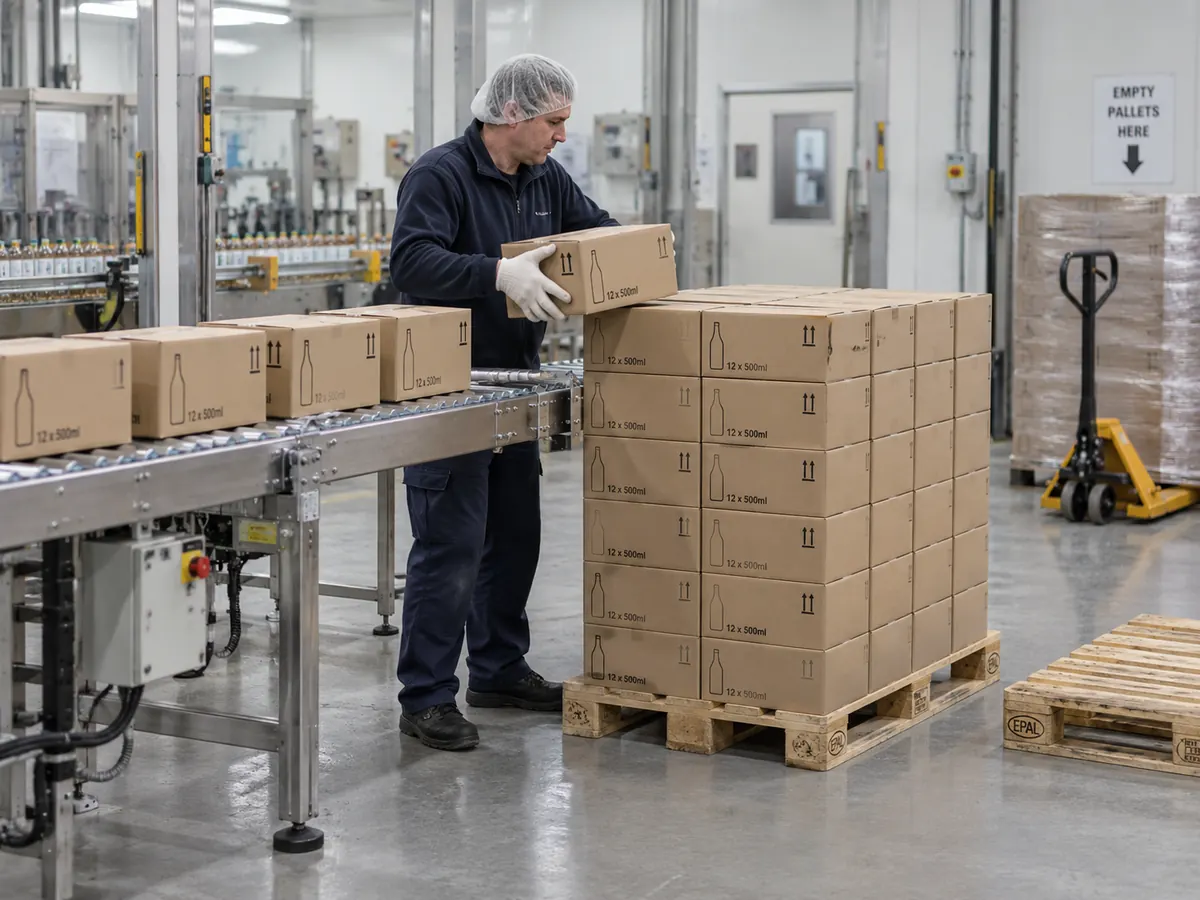
- End-of-line palletising: 12 kg cartons taken by hand from a conveyor discharge and stacked on a floor pallet, seven layers high
- Roles
- Palletiser (Line Operator), Line Supervisor, WHS Coordinator, Maintenance, Production Manager
- Modes
- Normal running, pallet exchange, promotional pack run (higher rate), relief operator on the station
- Standards basis
- WHS Regulations and the Code of Practice above · ISO 11228-1, governing · HSE INDG383 as method
- Method chain
- ErgoLens
- HTA
- REBA
- ErgoTempo
- NIOSH
- MAC
- Trigger
- Two injury reports, lower back, same station, six weeks apart, both closed as technique
- Captures
- ErgoSphere 1.6.2 · pending
Frame the problem
Plan 1: do 1.1, 1.2, 1.3 in order. Return to 1.1 if 1.3 changes the question.
1.1What the business asked for
PracticeNobody asked for an assessment. The Production Manager's covering note on the second report said what the first one had said: "Cartons are 12 kg. That's not a heavy lift. It's technique. Re-run the manual handling toolbox talk and get the new starters signed off." The first operator had been on the station for four years. The second was a relief operator in their third week.
A WHS Coordinator has a duty here that is easy to state and easy to skip: the regulations require the risks of hazardous manual tasks to be managed, and a task that has hurt two different people in six weeks has stopped being a training question. Two reports from one station is a finding about the station. The Coordinator did not know yet what was wrong with it. That was the job.
What could be done immediately was to go and look, with the injury reports in hand and a phone in a pocket. What could not be done was to write "technique" a third time.
1.2What the task actually is
PracticeLine 3 packs bottled product into cartons of twelve. The cartons come off a case sealer onto a short roller conveyor whose discharge end sits at 750 mm. The palletiser stands at the end of it. A floor pallet sits at a right angle to the conveyor, on the operator's right. Each carton is gripped at its ends, no handles, lifted off the rollers, turned through roughly ninety degrees at the trunk and placed in the layer pattern. Seven layers. The bottom layer is placed at 150 mm off the floor, the top at about 1400 mm. When the pallet is full the operator wraps it, pulls it clear with a pallet jack and drops an empty one in.
Both injured operators described the same moment: the bottom two layers, reaching down and across. Neither report recorded that, because the form asks what the person was doing, and both wrote "stacking cartons". The Supervisor, asked how fast the line runs, said "about two a minute, maybe a bit more on the promo pack".
Written as a question the methods can answer:
Is the palletising task within the capacity of the people who do it, and if not, which part of it, the weight, the height, the twist or the rate, carries the risk?
The pallet jack pull is a separate task with a separate method, and this example leaves it at the boundary with a note to come back to it.
"It's only 12 kg"
Every manual handling injury at a light-load station gets the same first explanation, because the weight is the one number everybody knows. Weight is one of six things that decide whether a lift is acceptable, and on a repetitive, low, twisted lift it is usually not the one that matters. The Coordinator's job at this stage is not to argue with the Production Manager. It is to write the question so the answer will name the factor, and then let the methods name it.
1.3The boundary, the roles, the modes, and the register
PracticeIn ErgoSphereThe boundary: the palletising station from the conveyor discharge to the finished pallet is in. The pallet jack pull and the empty-pallet fetch are out, noted as a separate push-pull assessment. The roles, as positions: the Palletiser as the primary user; the Line Supervisor and relief operators as secondary; Maintenance, who own the conveyor height and any lifting equipment, as the people the requirements will land on. The modes: normal running; pallet exchange; the promotional pack run, which is a different carton at a higher rate; and the relief operator, whose third week on the station produced the second report.
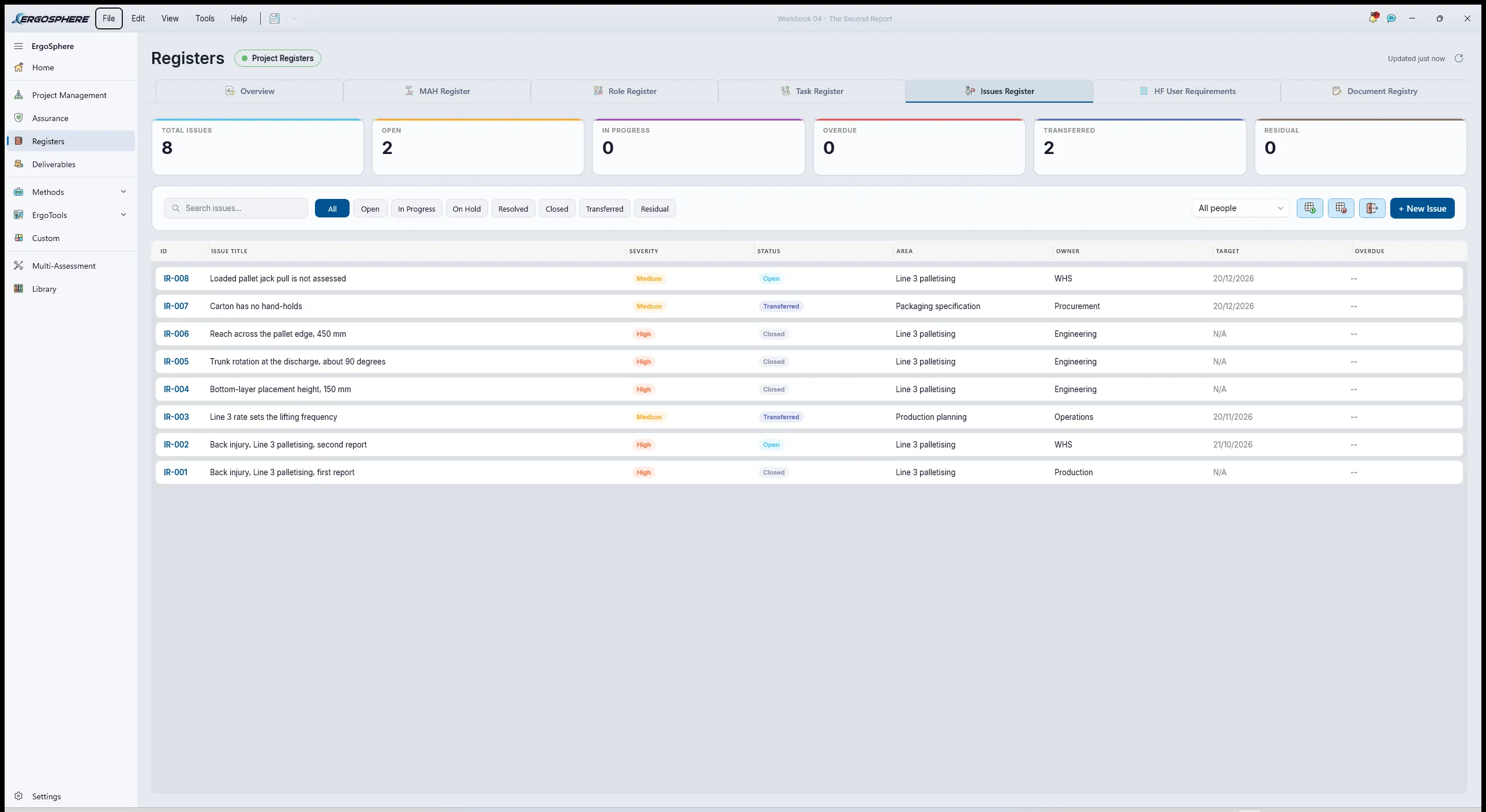
In ErgoSphere the project is created with the focus set to Manufacturing, which surfaces the physical tools first and hides nothing. The first thing entered is not an analysis. It is the Issues Register: the two injury reports go in with New Issue, one each, the Area set to Line 3 palletising, Safety critical ticked, the report's own words in the Source narrative, the operator's role and not their name, and a status of Open. The register opens before the analysis does, so that whatever the analysis finds is traced back to the two events that started it, and so that the Production Manager's "technique" is on the record as the current control.
The Early Human Factors Analysis wizard was not run, and that is a decision worth recording. It is a concept-stage instrument for a programme, with a standards lens chosen from IOGP 454, AS 7470 or MIL-STD-1472H, and none of those is a packing plant. Its manual handling probe would have said "RULA / REBA", which the Coordinator already knew. A wizard is not run because it is there.
Establish the standards basis
Plan 2: do 2.1; then 2.2 for the governing standard, part by part; then 2.3 for the method guide.
2.1How to find what applies
PracticeA WHS person usually knows the top of this list better than a Human Factors specialist does, and the bottom of it less well. It is assembled in order of authority, and when two documents disagree the higher one wins.
- The law and the regulator. The WHS Act and Regulations place a duty on the business to manage the risks of hazardous manual tasks, and they say what makes a task hazardous: repetitive or sustained force, high or sudden force, repetitive movement, sustained or awkward posture, vibration. This task has three of the five before anyone measures anything. The regulations say the risk must be managed. They do not say how to assess it.
- The Code of Practice. The Code of Practice on hazardous manual tasks is the regulator's own account of how the risk is identified, assessed and controlled, and in most jurisdictions it is admissible as evidence of what is known about the hazard. It is written for exactly this reader. It gives the hierarchy of control. It does not give a number for how heavy, how low or how often.
- The governing standard. ISO 11228, ergonomics of manual handling, in three parts: lifting and carrying, pushing and pulling, and handling of low loads at high frequency. Part 1 is the one that supplies what the Code does not: reference masses for a population, and the factors that reduce them for height, distance, twist, frequency and grip. Everything on this page that produces a number answers to it.
- The site's own system. The plant's WHS management system, its hazardous manual task procedure and its incident procedure. These sit under the standard and give it local teeth: they say who signs the risk assessment and who owns a control.
- Method guides. The HSE's manual handling assessment charts, published as INDG383, are a screening method, not a standard. They enter the register so that the assessment can say which method it used and which edition, and so the reviewer can see that the method was chosen and not just found.
A standard that gives numbers, under a code that gives duties
The three examples before this one were governed by process standards and design standards. This one is governed by the only kind most WHS people have met: a prescriptive one. ISO 11228-1 says what a lift may weigh for a given population, and by how much that mass is reduced when the hands are far from the body, the load is low or high, the trunk is turned, the lift is repeated or the grip is poor. The revised NIOSH lifting equation is the method most practitioners use to do that arithmetic, and it is the one the app implements. That is the leap on this page, and it is a small one: the standard supplies the reference mass and the reduction factors; the equation is how they are applied. The report says the task was assessed against ISO 11228-1 using the NIOSH revised lifting equation, and never that the station "complies with ISO 11228". Whether the plant complies with its duty is a claim the business makes, on this evidence, to its regulator. Clause numbers are deliberately absent from this page; on a real job they are checked against the edition the plant holds.
2.2ISO 11228, part by part
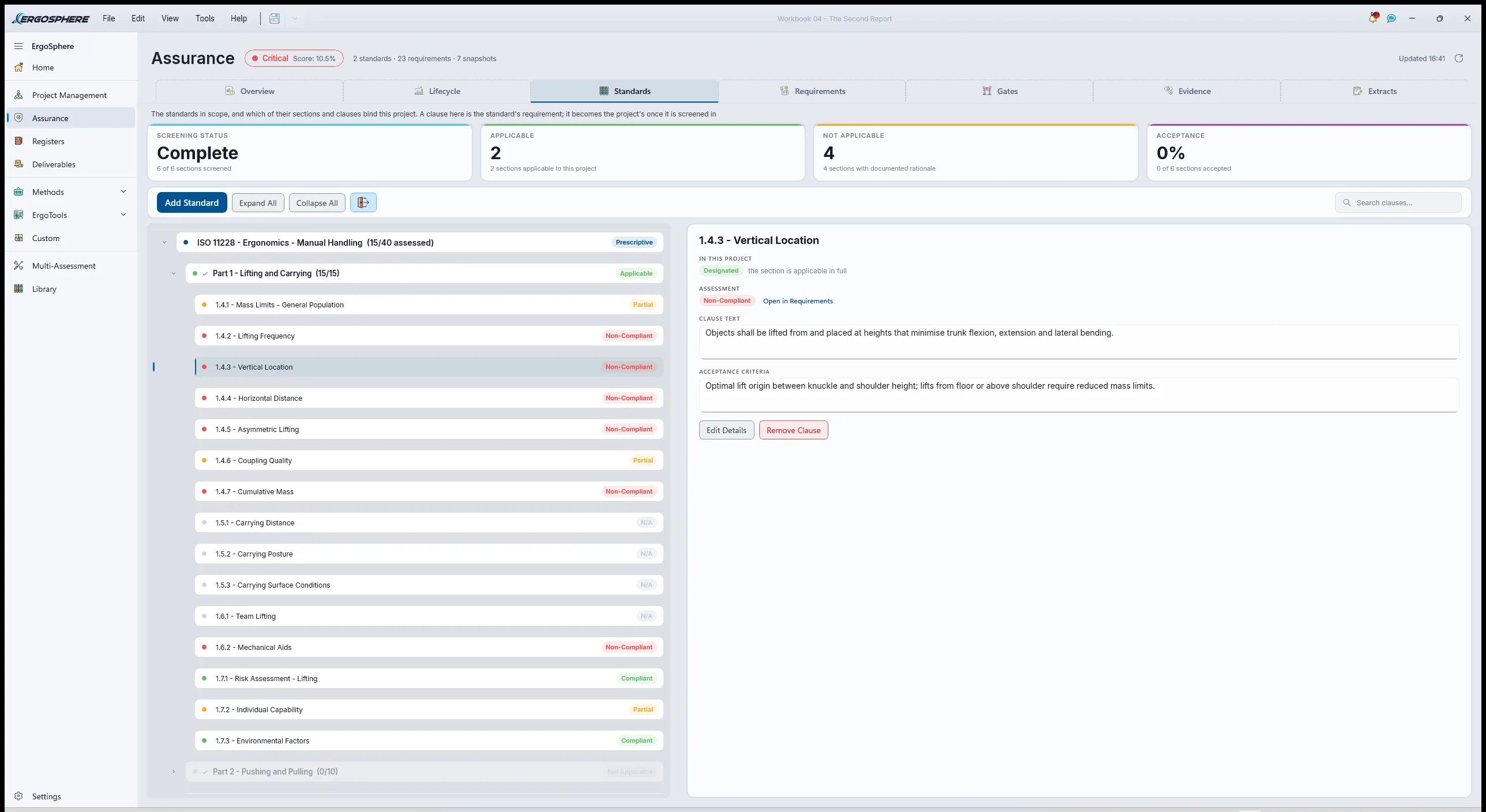
In ErgoSphereISO 11228 is in the Standards Register's library, one entry carrying all three parts. Add Standard, From library, and it arrives as a tree: the standard, its three parts as sections, and the clauses under each. Screening makes it the project's, section by section: Applicable, Partial or N/A, with who decided and when, and Confirm to lock it. Part 1, lifting and carrying, is Applicable in full; the carrying clauses stay in because the carton travels a metre in the hands between rollers and pallet. Part 2, pushing and pulling, is N/A with its one-sentence rationale in the box the app marks required: the pallet jack pull is outside this assessment's boundary and will be assessed separately. Part 3, low loads at high frequency, is N/A for a reason the standard itself gives: the carton is well above the mass that part is written for. Both exclusions are dated and attributed, and both appear in the Applicability Statement, so a reviewer can see that the Coordinator decided them rather than missed them.
2.3The method guide, entered as what it is
PracticeIn ErgoSphereHSE INDG383, the manual handling assessment charts, is also in the library, and it goes into the register in a different role from the standard. Its three sections are the three operations it covers: Lifting, Carrying and Team handling. Lifting is Applicable. Carrying is N/A, because the carton moves one metre in the hands and the chart's carrying operation is written for a walk. Team handling is N/A, because one person does the task. The register shows the standard type as it is, prescriptive guidance from a regulator in another country, and the professional judgement on the Lifting section says the one thing a reviewer needs: "Method guide adopted for screening under ISO 11228-1; the charts supply a structured walk of the risk factors, not a limit."
The Code of Practice and the site's own procedure are read and held in the Document Register, not entered clause by clause. They are cited in the judgement of the clauses they informed. Nothing that shaped a decision goes unrecorded, but not everything read needs a register entry.
Choose the methods
Plan 3: do 3.1; then 3.2 for each candidate method; then 3.3 to record the choices and the ones planned and not applied.
3.1The questions the methods must answer
Practice- Is there something here? Before a day is spent on it, does what the Coordinator saw at the station look like a posture problem at all? Cheap, fast, and allowed to be wrong in one direction only.
- Structure. What does the operator actually do, step by step, so that every method reads the same task and the finding can point at a step rather than at "stacking cartons"?
- Posture. At the worst step, how far from neutral is the body, under what load, and does that put the task in a band that requires change?
- Rate. How many lifts per minute, really, for how long a stint? Counted, not asked.
- Capacity. Given the height, the reach, the twist, the rate and the grip, what could a person be expected to lift here, and how far over that is 12 kg?
- Which factor. The question from 1.2. Two methods that name the same driver beat one that has to be argued for.
And one constraint the Coordinator was honest about: this was a WHS person's assessment, done between other duties, on a task that runs eight hours a day. The methods had to be ones a competent generalist can run and defend, and the data had to come from a shift that could be observed in an afternoon.
3.2The candidates, and the roads not taken
PracticeTaken
ErgoLens on a phone photo, as a flagOne photograph of a mid-layer placement, taken from behind and to the side at the station, imported and scored in minutes. A high score here is a reason to spend the afternoon. It is not a finding, and the page says why at 4.1 in the tool's own words.
Not taken
Go straight to a manual assessmentEntirely defensible, and what a specialist with a day booked would do. The Coordinator did not have a day booked. The photo cost nothing, it produced the argument for the day, and it gave the manual REBA something to check against.
Taken
REBA, by hand, at the stationThe task is a whole-body lift: trunk, legs and load carry the risk. REBA scores the neck, trunk and legs as one group and the arms as another, adds load, grip and activity, and puts the result in one of five risk bands with an action attached. It is the tool written for this posture.
Not taken
RULAThe one most WHS people have been shown, and the one this site runs free in the browser. It is an upper-limb tool: it was built for seated and standing work where the arms, wrist and neck carry the risk, and it treats the legs as supported or not. On a stooped, twisted floor-level lift it under-reads the very thing the injury reports describe. Right tool, wrong task.
Taken
ErgoTempo, one observed stintAn observation session with the task's steps as timed elements, run beside the station for twenty minutes. It produces the count of lifts, the time in each step and the time spent waiting, and those numbers feed the equation and the charts as observed values rather than remembered ones.
Not taken
Ask the Supervisor"About two a minute." Supervisors estimate rate from the line speed setting, not from the operator's hands, and a carton that arrives every thirty seconds on average arrives in bursts. The frequency multiplier is the steepest one in the equation. Taking it from memory would have put the largest error in the result on the least examined number.
Taken
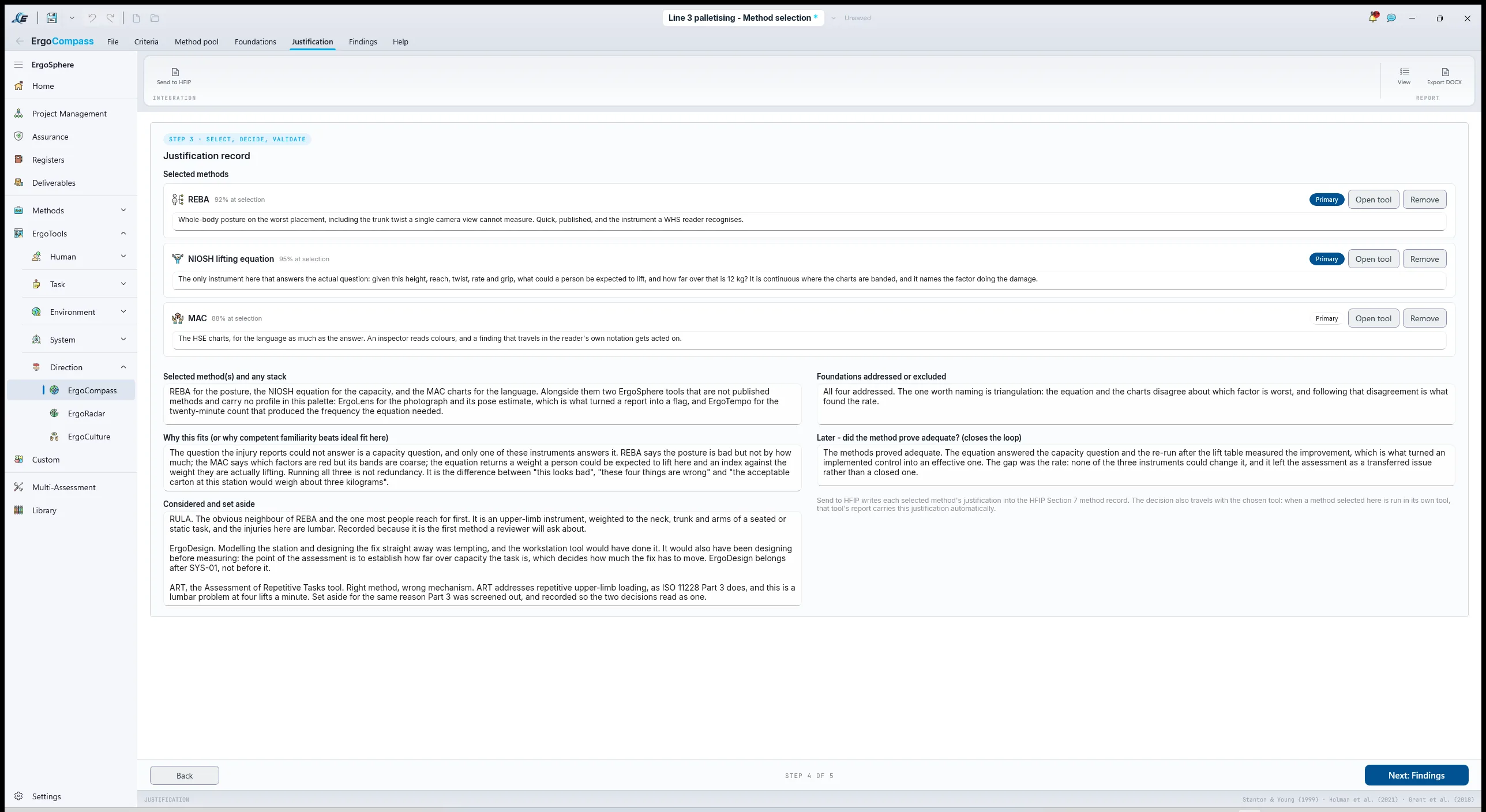
NIOSH lifting equation, then the MAC chartsThe equation gives a recommended weight limit for this exact lift and a Lifting Index that says how far over it 12 kg is, with every reduction factor shown, so the driver is named by arithmetic. The charts then walk the same task on the regulator's own factor list and colour each one. Two methods, two framings, one driver or not.
Not taken
ErgoDesign of the stationThe right next step if the fix were a new workstation: model the conveyor, the pallet and the figure, and place the layer heights in the reach envelope before anything is bought. Examples 01 and 03 walk it. Here the controls are a lift table and a conveyor turn, both catalogue items, and the retest at 7.3 is the cheaper proof. Considered, and set aside for the station's next redesign.
Two more methods were planned and not applied, and each is recorded with its reason. ART, the HSE's upper-limb repetitive task tool, because the risk this task presents is to the back and not the arms, and an ART score would have been a second number without a second finding. RAPP, the HSE's push-pull tool, because the pallet jack pull is a real task with a real risk and it sits outside this boundary; it is written into the plan as the next assessment, with a date.
3.3Recording the choice
In ErgoSphereErgoCompass starts with two plain questions: which industry, Manufacturing, and what kind of problem this mainly is, Physical demands on the body, which opens one more, the primary physical demand, Lifting / lowering. The problem statement goes in as the Coordinator wrote it at 1.2. The complexity tenets are rated low: one role, one station, an observable task, a known population. Answering Physical matters for more than the extra question: it moves the tool onto a different pool. The cognitive route ranks against Holman's set of predictive cognitive and systems methods, which contains no physical assessment tool at all; the physical route ranks against ErgoSphere's own physical catalogue, which is where REBA, the NIOSH equation and the MAC live. The palette puts those three at the top with suitability scores of 92, 95 and 88 per cent, and the foundations check asks the question a WHS person most often skips, whether there is a task decomposition under the assessment. There will be, at 4.2. The justification record carries the selected methods, why they fit, and Considered and set aside, which is the four forks above, RULA and ErgoDesign named with their reasons.
Send to HFIP writes the justification into an Integration Plan. On a job this size the plan is two pages, and that is fine; the Planned and not applied section carries ART and RAPP with their reasons, and the RAPP line carries a date, so the pallet jack is a decision on the record and not a gap.
Run the analysis
Plan 4: do 4.1 on the day of the second report. If it flags, do 4.2, then 4.3 and 4.4 on the same shift, then 4.5 and 4.6 from the observed values.
4.1The photo, in ErgoLens: a flag, not a finding
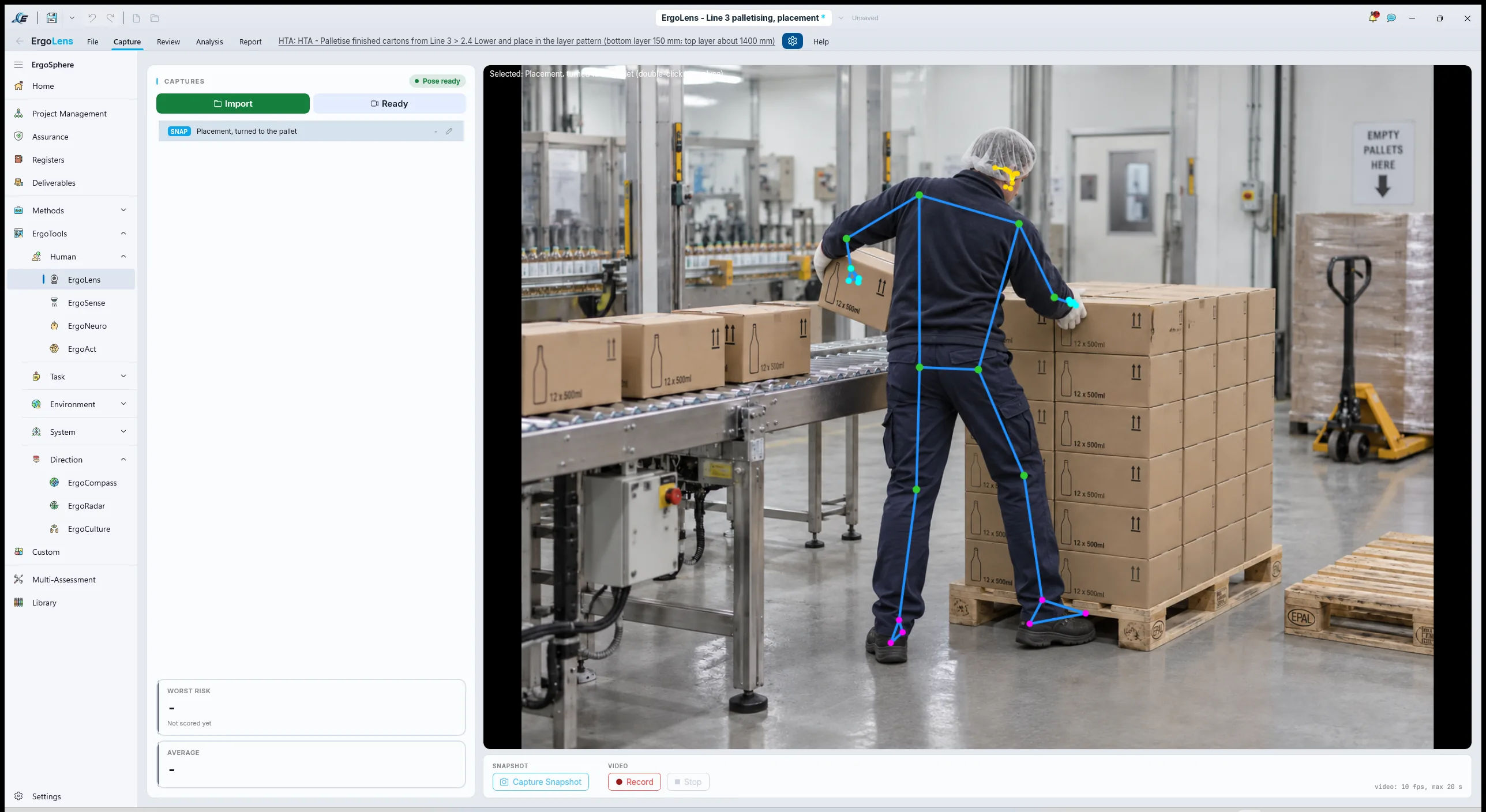
PracticeIn ErgoSphereThe Coordinator took one photograph from a few metres back and a little behind the operator, as a mid-layer carton went down onto the part-built pallet. Whole body in frame, the carton in the hands, the pallet to the operator's right. That is the whole of the field work at this step, and it took less time than reading this paragraph. Note what the shot is not: it is not the bottom layer at 150 mm, which is the worst lift of the seven and the one the tape measurements and both NIOSH runs are taken on later. The photograph raises the flag. It is not the measurement.
Back at the desk the photograph goes into ErgoLens. The tool has four stages, Capture, Review, Analysis and Report. On the Capture step, Import, then Import Image; a still photograph is accepted alongside video and a live camera. The pose model draws its landmarks on the figure and the pill reads Pose ready. The two risk tiles at the bottom of the Capture step still read "Not scored yet" at this point, which is correct and worth noticing: a still has a pose but no score until the Review step applies a worksheet to it. On the Review step the tabs are Frame Score, RULA and REBA. There is no NIOSH tab on a still, and that is the right behaviour rather than a gap: a lifting equation needs a start and an end, and a photograph has neither, so the tab appears for video captures only.
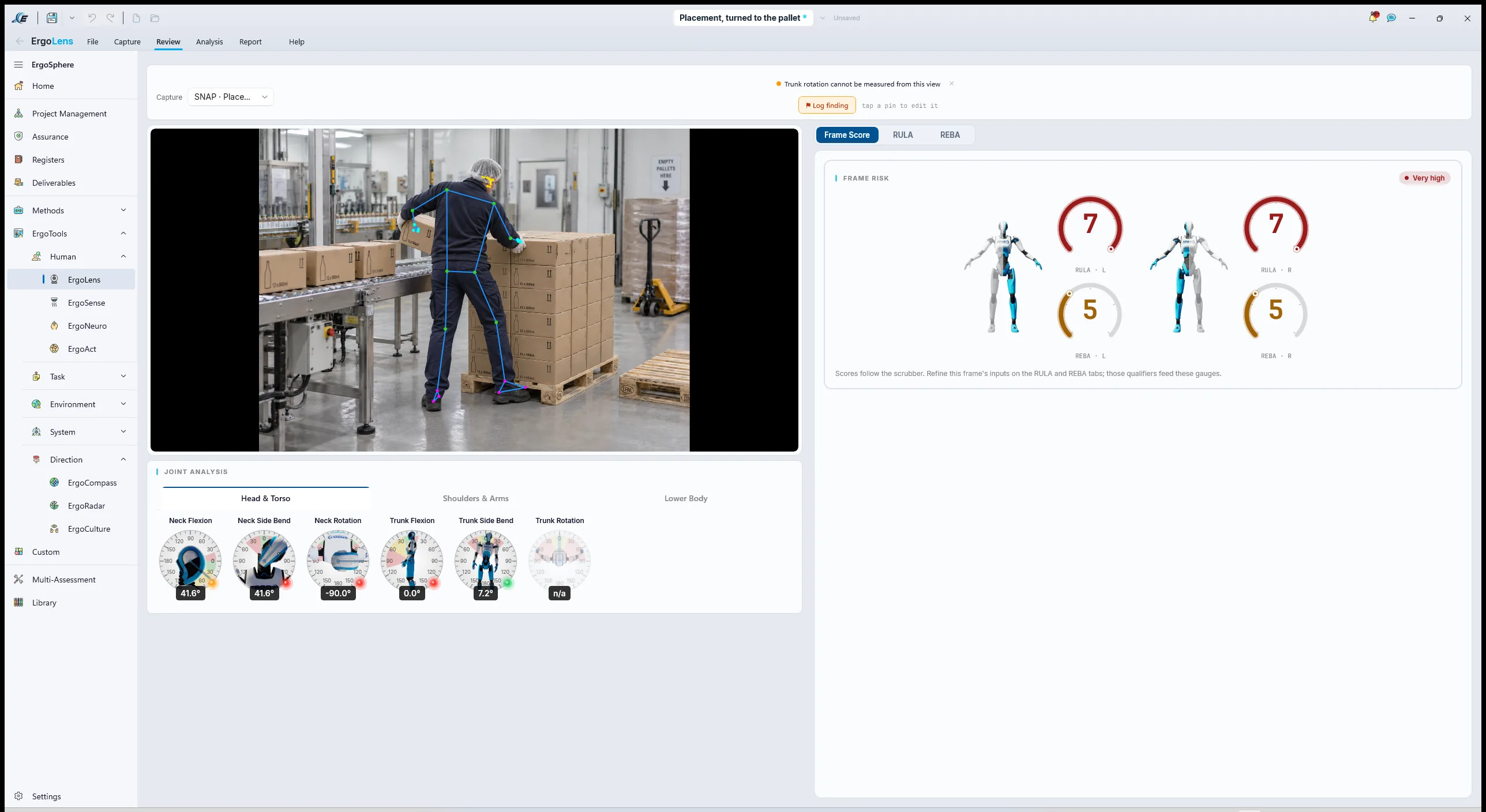
The frame comes back Very high. RULA is 7 on both sides, the top of its scale; REBA is 5 on both sides, which is its medium band. Two worksheets over one posture, disagreeing about how bad it is, is normal and it is informative: RULA weights the neck and arms, which this frame has in abundance, and REBA weights the trunk and legs, which from this angle it can barely see.
Now the part that matters, and it is the tool refusing rather than the tool scoring. The trunk rotation dial reads n/a, greyed out, with the reason on screen: rotation about the spine's long axis cannot be recovered from a single 2D camera view. The Coordinator had watched the operator turn ninety degrees to the pallet on every carton. The lens could not see it, and it said so instead of reporting zero. Read the dial beside it and the same limitation shows up a second time: trunk flexion 0.0°, from a camera standing behind a man who is plainly leaning into the pallet. Forward lean is out of the image plane from that angle, so the lens cannot measure it either. The instrument under-read this task twice over, in the two channels that carry most of its risk, and it still came back Very high.
The finding is logged from the frame with Log finding, at Severity Medium, with a title that says what it is: "Trunk rotation cannot be measured from this view". Medium, not High, because a lens estimate from one oblique frame is a reason to look, not a result, and because the number it produced is provably the lower bound. The manual REBA at step 4.3, taken on the bottom layer with the twist observed rather than assumed, comes out at 10.
What a lens can and cannot see
Camera-based posture estimation is a screening instrument. It reads the joints it can see from the angle it was given, and it is honest about the rest: sagittal flexion is not observable from a front view, abduction is not observable from a side view, an oblique view makes the split between them a low-confidence estimate, and rotation about the spine is not measurable from any single 2D view at all. The app says each of those on the dial it applies to. A depth capture or a wearable measures what a photo cannot, and Example 03's sister tool, the wearable capture, is the instrument for that. On a WHS person's afternoon the photograph is the right first instrument, precisely because it costs nothing and is allowed to be wrong in one direction: it can miss a twist, which under-reads the risk, so a high score from it is a high score. The rule the Coordinator wrote in the finding's description: a lens score is the reason to assess, never the assessment.
4.2HTA of the palletising task
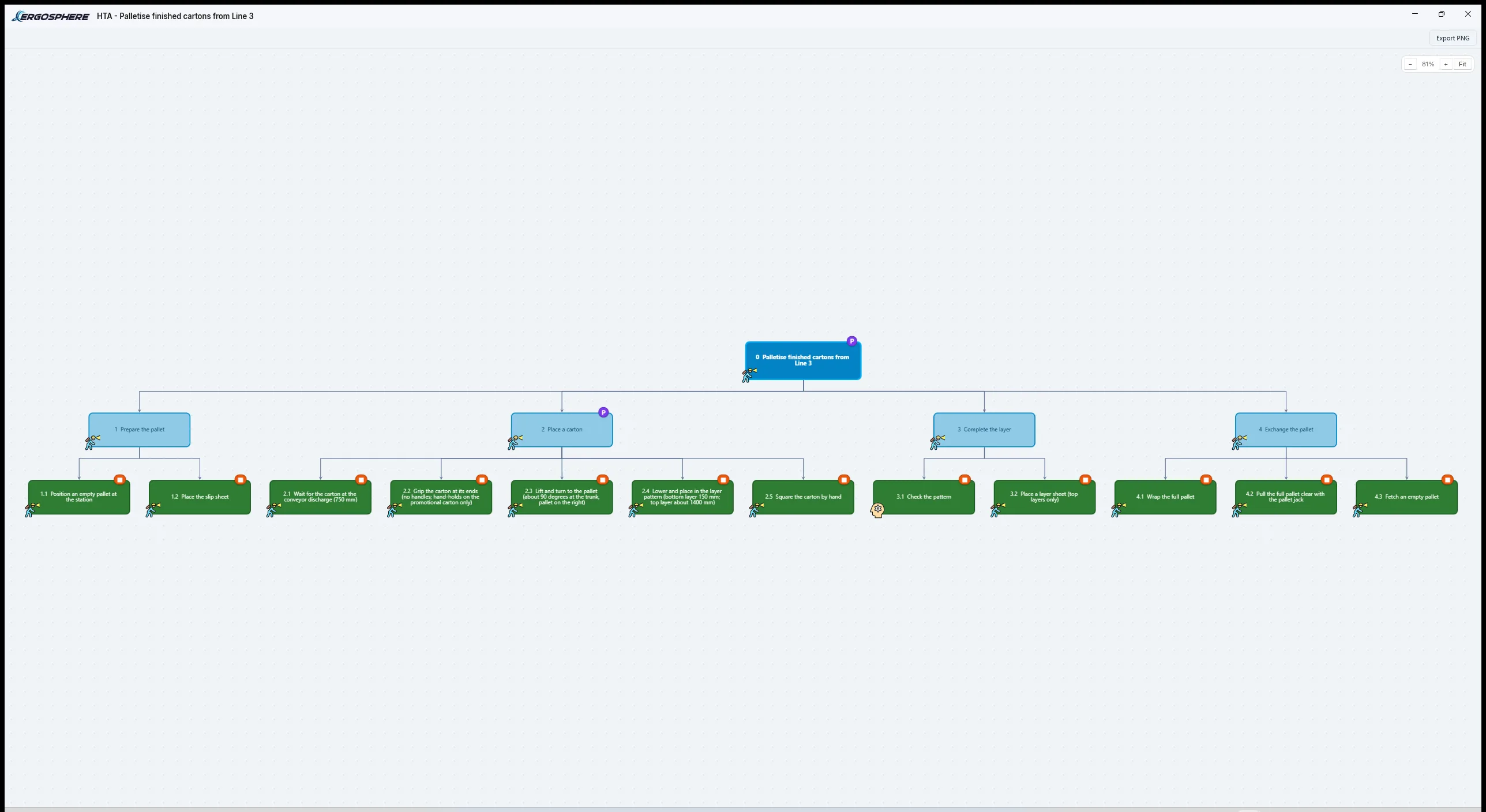
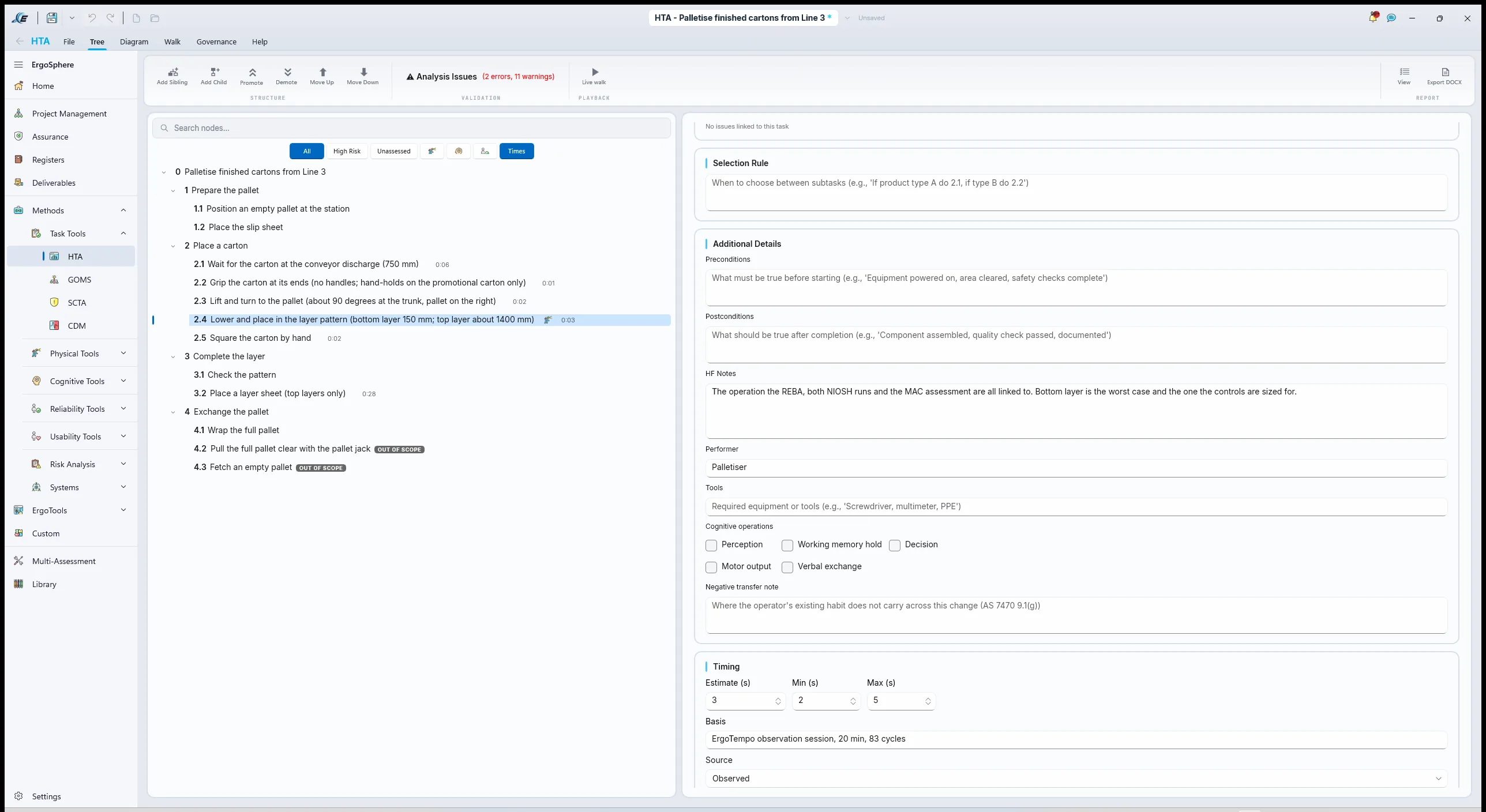
PracticeIn ErgoSphereThe afternoon starts with a task analysis, and a WHS person's first instinct is to ask why. The answer is that every method that follows needs to point at a step. "Stacking cartons" hurt two people; "2.4, lower and place in the bottom layer, 150 mm, turned ninety degrees" is a step a control can be written against. The tree also does something the injury form could not: it separates the lift, the turn and the placement, which the equation treats as different multipliers, and it puts the pallet exchange and the pallet jack where they belong, at the boundary.
The data came from one observed stint and ten minutes with the operator afterwards, which is where the plan came from. The operator knew the layer pattern and the moment the top layers get easier, and said the promotional carton is the same weight in a bigger box, which is a grip finding nobody had written down. Decompose where the risk lives and stop where it does not: the pallet preparation and the wrap stop at sub-task, the carton placement goes all the way down.
- 0Palletise finished cartons from Line 3
0: do 1 at the start of each pallet; do 2 for every carton until the layer is full; do 3 at each full layer; do 4 when the pallet is full; then 1.
- 1Prepare the pallet
- 1.1Position an empty pallet at the station
- 1.2Place the slip sheet
- 2Place a carton
2: do 2.1 as the carton arrives; then 2.2, 2.3, 2.4 in sequence; do 2.5 if the carton sits out of pattern.
- 2.1Wait for the carton at the conveyor discharge (750 mm)
- 2.2Grip the carton at its ends (no handles; hand-holds on the promotional carton only)
- 2.3Lift and turn to the pallet (about 90 degrees at the trunk, pallet on the right)
- 2.4Lower and place in the layer pattern (bottom layer 150 mm; top layer about 1400 mm)
- 2.5Square the carton by hand
- 3Complete the layer
- 3.1Check the pattern
- 3.2Place a layer sheet (top layers only)
- 4Exchange the pallet
- 4.1Wrap the full pallet
- 4.2Pull the full pallet clear with the pallet jack (out of boundary; push-pull assessment planned)
- 4.3Fetch an empty pallet (out of boundary)
- 1Prepare the pallet
Twelve operations at the leaves, ten of them in boundary, and the risk lives in two of them: 2.3 and 2.4. In ErgoSphere the tree is built on the Tree view with Add Child and Add Sibling, the numbering is automatic, and the Diagram view beside it draws the same structure without editing it, and each node carries its Plan, its Performer, its Preconditions and its HF Notes. Every node also carries a Timing card, Estimate, Min and Max in seconds, a Basis and a Source, and at this point every one of them reads Not timed. That is deliberate. The times arrive at 4.4, observed, and the card will say so.
How to build an HTA of a manual task
- Name the top goal as the outcome. "Palletise finished cartons" is a goal. "Lift cartons" is an operation inside it.New HTA session. The root node is 0; its Goal field is the sentence.
- Ask what has to happen for the goal to be met. Prepare, place, complete, exchange. Four children, and the plan says when each runs.Select the node, Add Child. Add Sibling for the next at the same level. Numbering is automatic.
- Write the plan on every parent. Plans are where the rate lives: "for every carton until the layer is full" is the sentence the equation will need.The Plan field, with its helper text; or a formal expression the tool plays back.
- Split the lift into its physical parts. Grip, lift and turn, lower and place. A lifting equation has different multipliers for each, and a control usually fixes one of them.Three children under the placement node, each with its own HF Notes on height, reach and twist.
- Put the boundary on the tree. Operations outside the assessment stay on the tree and are marked so the reader can see what was left out and why.The HF Notes on 4.2 and 4.3 name the planned push-pull assessment.
- Leave the times empty until they are observed. A timing typed from memory carries the same weight on the page as one that was measured, so the card records which it is.The Timing card: Estimate (s), Min (s), Max (s), Basis, and Source, which stays at Not recorded until 4.4.
- Read it back to the operator. Every "no, the layer sheet only goes on the top three" is a plan correction.The standing validator flags parents without plans as you go.
4.3REBA by hand, at the bottom layer
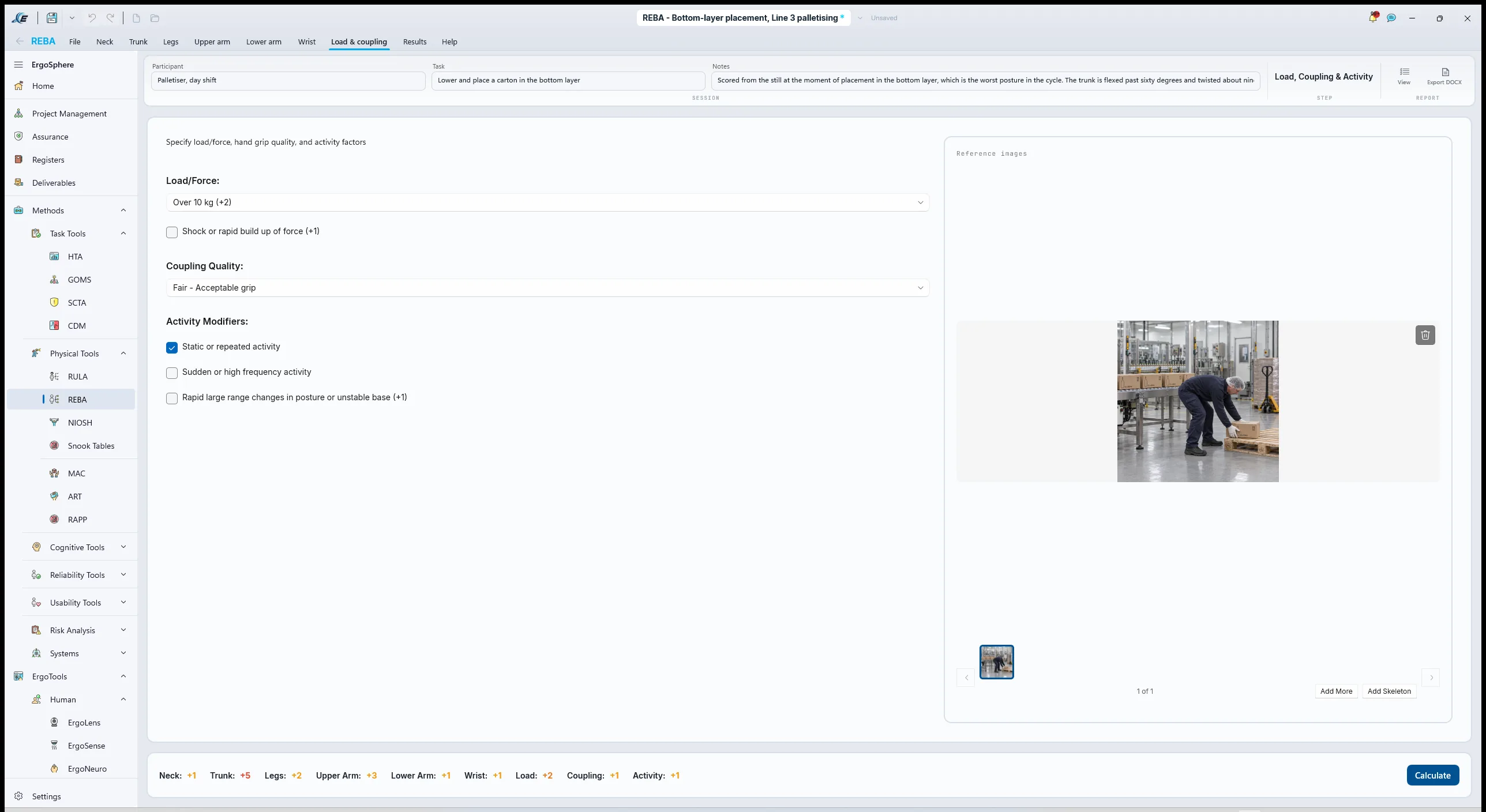
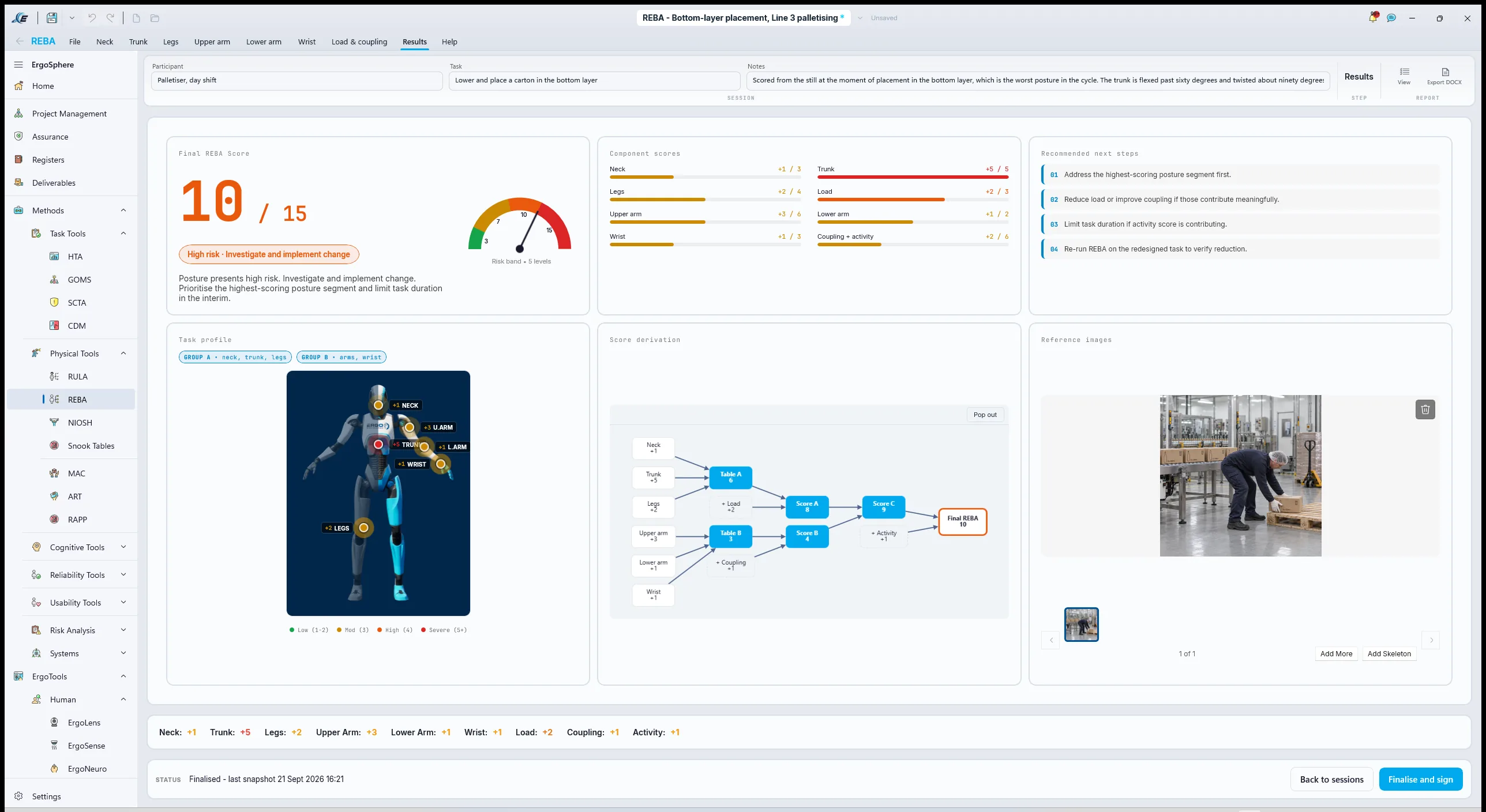
PracticeIn ErgoSphereREBA is done standing beside the station, watching the operator place the first two layers of a fresh pallet, and it is done on the worst moment, not the average one. The posture at 2.4 on the bottom layer: trunk flexed past sixty degrees and turned; neck slightly flexed; both feet on the floor with the knees between thirty and sixty; upper arms reaching forward over the pallet edge at about fifty-five degrees and unsupported; forearms inside the neutral band; wrists near neutral. Then the three modifiers: the load is over 10 kg, the coupling is fair at best on a carton with no handles, and the activity is repeated more than four times a minute, which the next step will confirm.
In ErgoSphere the REBA editor is a wizard in the order the method is scored: Neck Position, Trunk Position, Legs & Support, Upper Arm Position, Lower Arm Position, Wrist Position, then Load, Coupling & Activity, then Results. The SIDE group on the ribbon is set to Right, the side the pallet is on, and the score strip along the top fills as each step is answered. On the load step the bands are the method's own: Over 10 kg (+2), coupling Fair, and Static or repeated activity. The results page gives the Group A score for neck, trunk and legs, the Group B score for arms and wrist, the Final REBA Score, and the risk band with its action. Beside the steps there is a Reference images panel, and the photograph of the placement goes in there, so the posture that was scored travels with the score rather than living in somebody's phone. The same panel exists on the NIOSH editor and takes the tape measurements at 4.5. It is worth knowing that these images are stored beside the project rather than inside it, so they stay on the assessor's machine and do not travel in a shared project file.
| Element | Observed | Score | Note |
|---|---|---|---|
| Neck | Flexed, under 20 degrees | 1 | Looking at the placement |
| Trunk | Flexed past 60 degrees, twisted | 4 + 1 | The twist the lens could not see |
| Legs | Both feet, knees 30 to 60 degrees | 1 + 1 | A half squat, not a full one |
| Group A | Neck, trunk, legs, plus load over 10 kg | 6 + 2 = 8 | Load is the modifier here, not the driver |
| Upper arm | About 55 degrees, reaching forward over the pallet edge, unsupported | 3 | The 45 to 90 band, not the one below it |
| Lower arm | About 75 degrees, inside the neutral band | 1 | The forearm is the one thing here that is fine |
| Wrist | Near neutral | 1 | |
| Group B | Arms and wrist, plus fair coupling | 3 + 1 = 4 | Fair, for a carton with no handles |
| Final REBA | Table C of Group A 8 and Group B 4, plus repeated activity | 9 + 1 = 10 | High risk · Investigate and implement change |
The photograph's REBA frame score had been 5, on a view that could measure neither the twist nor the forward lean. The manual assessment, on the bottom layer with both observed rather than estimated, came out at 10. That gap of five points is the whole argument for step 4.3 existing: the flag was right, and it was also the floor. The trunk was the reason in both passes. Finalise and sign marks the assessment complete and writes a compliance snapshot the Requirements workspace can read at stage 7; a finalised REBA is a record, and an unfinalised one is a draft.
How to run a REBA
- Pick the moment, not the task. REBA scores one posture. Choose the worst credible one the task requires, and say which step of the HTA it is.New REBA session; the session notes name HTA node 2.4, bottom layer.
- Choose the side. The side doing the work, or the worse of the two if they differ.SIDE: Left or Right on the ribbon.
- Score Group A: neck, trunk, legs. Angles from neutral, then the adjustments: twisted, side-bent, one leg, knees bent. Watch for the twist, because it is the one a photograph hides.Neck Position, Trunk Position, Legs & Support, with the adjustment tick boxes on each step.
- Add the load. Under 5, 5 to 10, over 10 kg, and whether the force arrives suddenly.Load, Coupling & Activity: the load bands as the method names them.
- Score Group B: upper arm, lower arm, wrist. Then the coupling: good, fair, poor, unacceptable. A carton with no handles is fair on a good day.Upper Arm Position, Lower Arm Position, Wrist Position, then the Coupling band.
- Add the activity. Static, repeated more than four times a minute, or rapid large changes in posture.Static or repeated activity, or Sudden or high frequency activity.
- Read the band, not just the number. Negligible, low, medium, high, very high, each with an action. High means investigate and implement change; it does not mean "monitor".Results: Final REBA Score, the Group A and Group B tiles, the risk band pill, and Recommended next steps.
- Finalise it. A signed assessment is evidence. A draft is a note.Finalise and sign; the status reads Finalised with the date and the snapshot recorded.
4.4ErgoTempo: counting the lifts
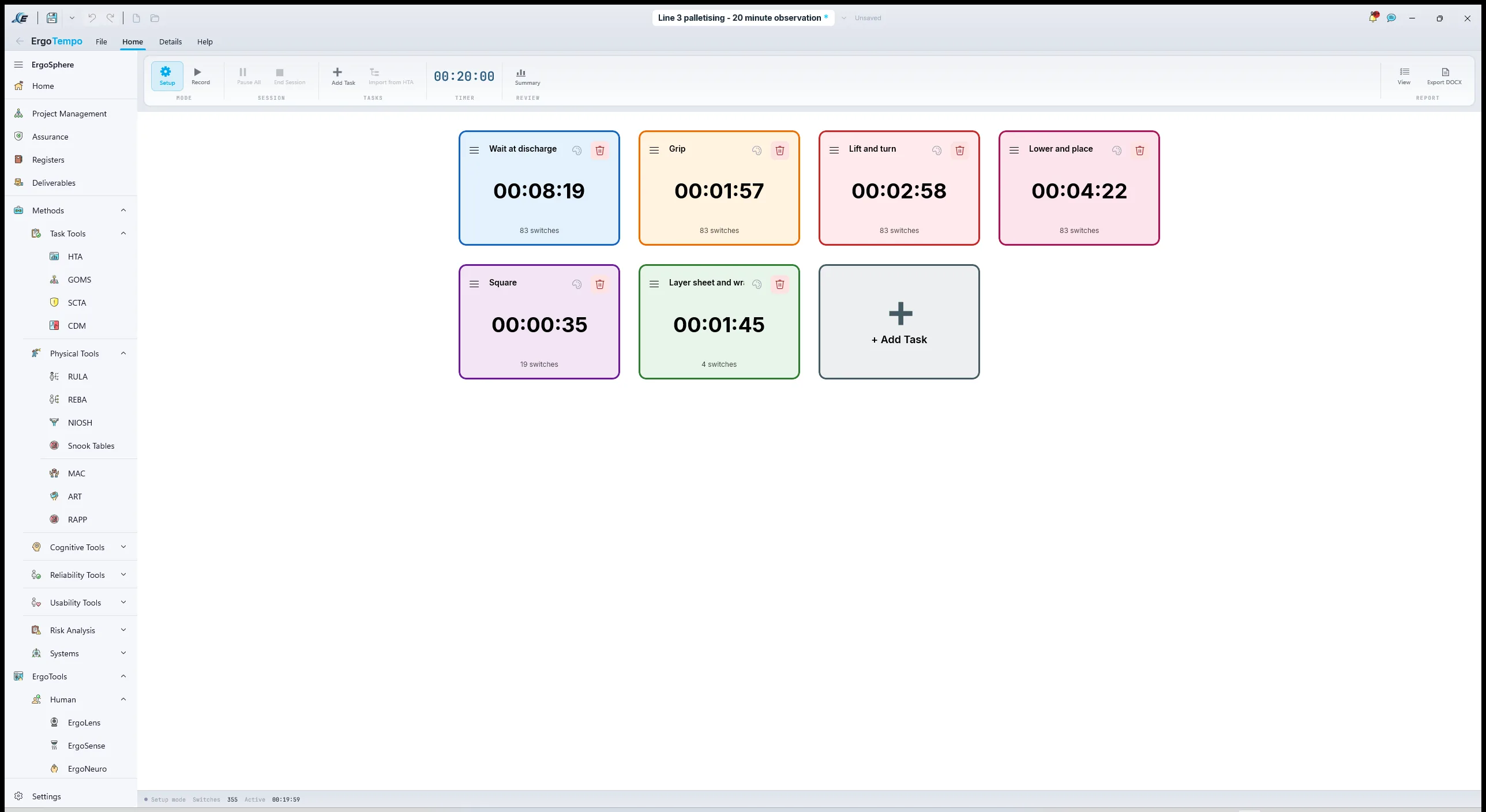
PracticeIn ErgoSphereThe equation at 4.5 and the charts at 4.6 both want a frequency, and the Supervisor's "about two a minute" is the number the Coordinator most needed not to trust. A time and motion observation answers it, and it answers something else on the way: how much of the operator's time is spent waiting, standing at the discharge end with nothing in the hands, which is the number the Production Manager will ask about when the rate comes up.
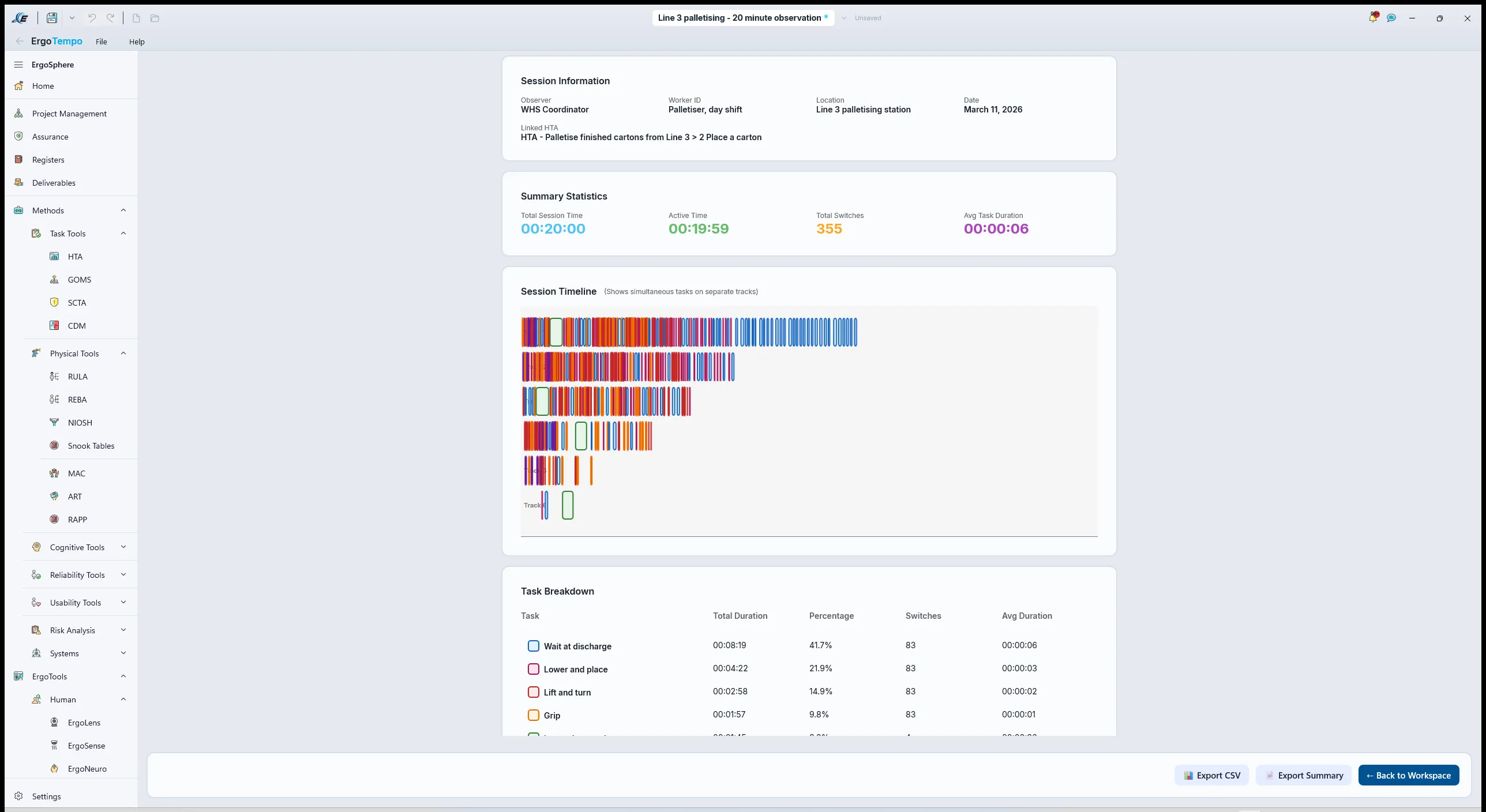
ErgoTempo runs an observation session. The HTA's placement operations become task cards, Add Task for each, up to twenty: Wait, Grip, Lift and turn, Lower and place, Square, and one for the layer sheet and wrap together. Setup mode to lay them out, then Record mode to start the session, and from there it is one tap per switch: the operator's hands go to the carton, tap Grip; the carton leaves the rollers, tap Lift and turn; it lands, tap Lower and place. Pause All at the pallet exchange, End Session at twenty minutes. End Session goes straight to the Summary, which is a page of its own rather than a tab: Session Information with the linked HTA node, Summary Statistics reading Total Session Time 00:20:00, Active Time 00:19:59, Total Switches 355 and Avg Task Duration 00:00:06, a Session Timeline that draws simultaneous tasks on separate tracks, and the Task Breakdown table with each task's Total Duration, Percentage, Switches and Avg Duration, sorted longest first.
| Task | Total | Share | Switches | What it says |
|---|---|---|---|---|
| Wait at discharge | 00:08:19 | 41.7% | 83 | Standing, empty-handed, between cartons. The rate is the line's, not the operator's |
| Lower and place | 00:04:22 | 21.9% | 83 | The placement itself, and the operation every control is written against |
| Lift and turn | 00:02:58 | 14.9% | 83 | The twist, eighty-three times |
| Grip | 00:01:57 | 9.8% | 83 | Longer on the promotional carton, which has hand-holds |
| Layer sheet and wrap | 00:01:45 | 8.8% | 4 | The only rest from lifting in the stint |
| Square | 00:00:35 | 3.0% | 19 | Roughly one carton in four, mostly the bottom layer |
Eighty-three cartons in twenty minutes is 4.2 lifts per minute, twice the Supervisor's figure, and the stint runs the full shift with a break at the pallet exchange. Those are the two inputs the equation was waiting for: frequency and duration. The forty-one percent waiting is not idle time in any sense that matters to the back; it is standing, and it is the reason a rotation to a seated task counts as recovery.
ErgoTempo does not write into the HTA, so the last thing done on this step is done by hand, and the page says so plainly. The averages from the Task Breakdown are typed onto the HTA nodes' Timing cards: 2.3 Lift and turn at 2 seconds, 2.4 Lower and place at 3 seconds with a range of 2 to 5, each with Basis "ErgoTempo observation session, 20 min, 83 cycles" and Source set to Observed. From now on anyone who opens the tree sees a measured time and the session it came from, not a guess with the same typeface as a fact.
How to run a time and motion observation
- Make the elements the HTA's operations. If the tree and the stopwatch disagree about what the task is, one of them is wrong, and it is usually the stopwatch.Add Task for each operation in scope; name them as the HTA names them.
- Include waiting as an element. It is the number that shows whether the person or the line sets the pace.A "Wait" task card of its own, first in the list.
- Observe a whole cycle, not a sample of lifts. Twenty minutes covers a pallet exchange and both the easy and the hard layers.Setup mode to arrange the cards, Record mode to start; Pause All at the exchange if it is out of scope.
- Tap on the transition, not the action. The hands leaving the rollers is the switch, not the lift itself.One tap on the card the operator has just moved to; the timer runs on.
- Stop at a planned time and read the summary. Switches per task is the count; Avg Duration is the time; Percentage is the share of the stint.End Session, then Summary: Summary Statistics and the Task Breakdown table.
- Carry the times to the HTA, and say they were observed. The stopwatch's numbers become the tree's numbers only when the tree records where they came from.Typed onto each node's Timing card: Estimate (s), Min (s), Max (s), Basis naming the session, Source set to Observed. There is no automatic feed; the Basis line is the trace.
4.5The NIOSH lifting equation, bottom layer
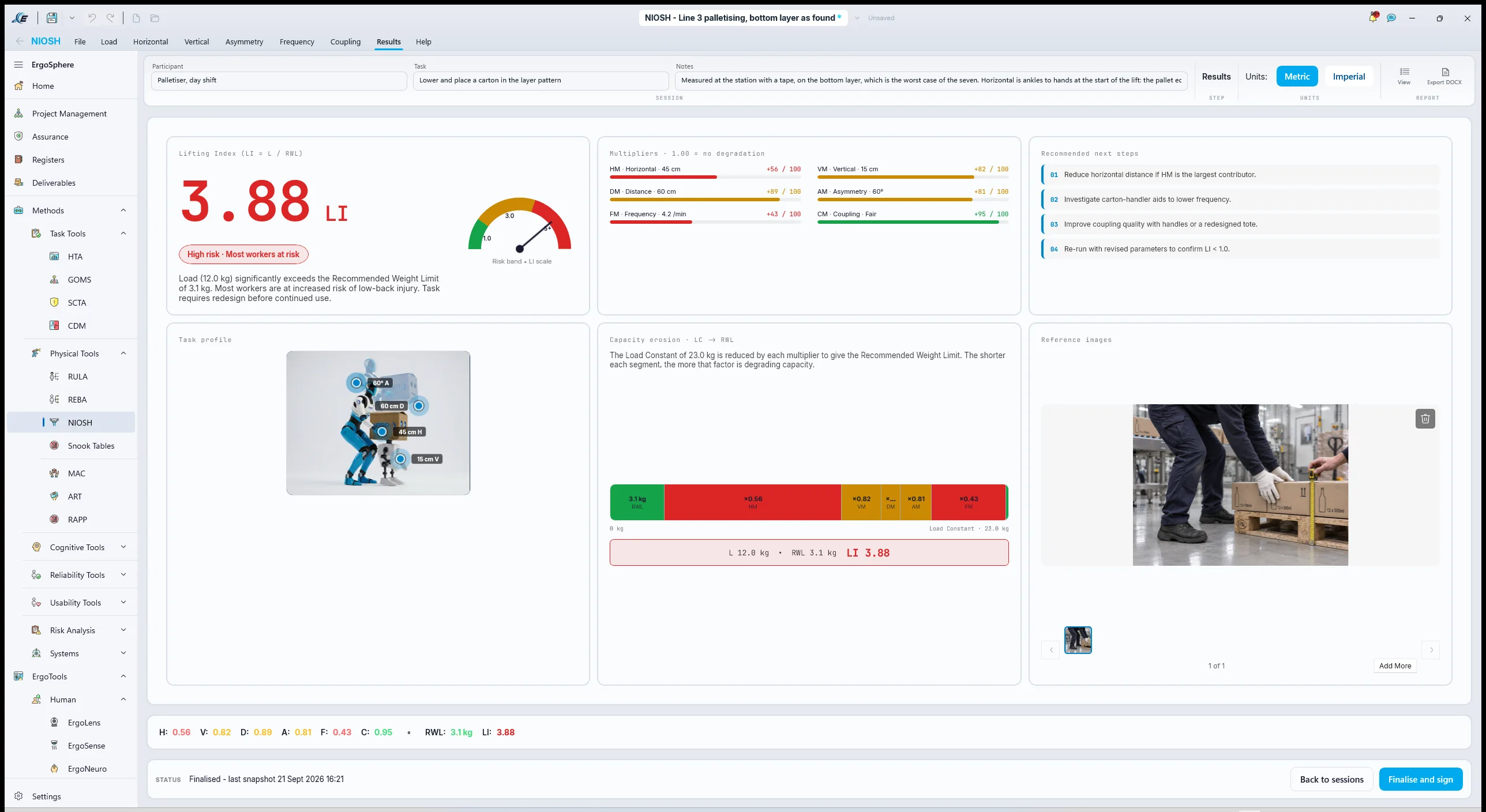
PracticeIn ErgoSphereThe equation starts from a reference mass, the load constant, that a healthy working population could lift under ideal conditions, and reduces it by a multiplier for each way this lift is not ideal: how far the hands are from the body, how low or high they start, how far the load travels, how far the trunk turns, how often the lift repeats and for how long, and how good the grip is. The result is the recommended weight limit for this lift, and the Lifting Index is the actual load divided by it. Under 1 the lift is within the limit for most of the population; between 1 and 3 some workers are at risk; over 3, most are.
The measurements are taken at the station with a tape: horizontal distance from the ankles to the hands, 450 mm on the bottom layer because the pallet edge keeps the operator back from the placement; the two ends of the travel at 150 mm and 750 mm; asymmetry 60 degrees, the trunk turn from the conveyor to the pallet; frequency 4 per minute from 4.4, for a long duration; coupling fair. In the editor these go in as centimetres, not millimetres, which is the unit every distance field on the page is labelled with.
One thing about this lift needs saying before the numbers, because a reader who checks the session will notice it. Taking a carton off a 750 mm conveyor and putting it down at 150 mm is a lowering, and the equation is written for lifts. A lowering is assessed as the lift that reverses it, so the low end goes in as the origin: origin 150 mm, destination 750 mm. That is not a clerical detail. The vertical multiplier is taken from the origin, so entering the conveyor as the origin instead returns a vertical multiplier of 1.00 and reports that the height of this task costs nothing, on the one lift where the height is the reason the lift table gets bought.
In ErgoSphere the NIOSH editor walks those in order: Load Information, with the load weight and the duration of the lifting task set to Long Duration; Horizontal Distance; Vertical Position, with Vertical Origin and Vertical Destination as separate fields so the travel is derived rather than typed; Asymmetry Angle; Frequency, in lifts per minute; Coupling Quality; then Results. The results page shows the Lifting Index on a gauge, the recommended weight limit against the load, and a tile the page is named for: Capacity erosion, LC to RWL, each multiplier drawn as a bar so the reader sees which factor took the capacity away.
| Multiplier | Measured | Bottom layer | Top layer | What it says |
|---|---|---|---|---|
| Horizontal | 450 mm / 400 mm | 0.56 | 0.63 | The reach across the pallet edge |
| Vertical | 150 mm / 1400 mm | 0.82 | 0.81 | Low is as bad as high |
| Distance | 600 mm / 650 mm of travel | 0.89 | 0.89 | |
| Asymmetry | 60 degrees | 0.81 | 0.81 | The twist REBA scored |
| Frequency | 4.2 per minute, long duration | 0.43 | 0.43 | The steepest cut, from the count at 4.4 |
| Coupling | Fair, no handles | 0.95 | 1.00 | |
| Recommended weight limit | from a 23 kg load constant | 3.1 kg | 3.6 kg | What this lift, as designed, would be acceptable at |
| Lifting Index | 12 kg carton | 3.88 | 3.4 | High risk · Most workers at risk, both layers |
Read the multipliers before the index. The load constant of 23 kg has been cut to 3.1 kg on the bottom layer, and the frequency multiplier was the single largest cut. The reach was the next. The twist and the height each took a further fifth. The weight of the carton does not appear in the multipliers at all; it appears only at the end, as the numerator of the index, and 12 kg over 3.1 kg is 3.88. The Production Manager was right that 12 kg is not a heavy lift. The equation says this station makes it one. The top layer, which nobody complained about, is at 3.4: a shorter reach, a worse height, the same rate. Neither layer is acceptable, and the one the site thought was fine is barely better than the one that hurt two people.
How to apply the NIOSH lifting equation
- Check the equation applies. Two hands, standing, no restricted space, a stable load, not a one-handed or seated lift. If it does not apply, say so and use a different method.Load Information: the one-handed tick box takes the equation out of scope and the results page says so.
- Measure, do not estimate. Horizontal from the ankle midpoint to the hands; vertical at the hands at origin and destination; asymmetry as the angle the load is turned through. A tape and a protractor at the station.Horizontal Distance, Vertical Position with Vertical Origin and Vertical Destination, Asymmetry Angle, in the units toggled on the page.
- Take the frequency from an observation. Lifts per minute averaged over the stint, and the duration category the stint actually runs.Frequency (F) in lifts per minute, from the ErgoTempo count; Duration of Lifting Task on the first step.
- Grade the coupling honestly. Good is a handle. Fair is a carton that can be gripped. Poor is a sack.Coupling Quality: Good, Fair or Poor, with the definition on each.
- Assess origin and destination separately if they differ. The worst end governs. Here it is the destination on the bottom layer and the origin on the top.One session per lift assessed; the session notes say which end and which HTA node.
- Read the multipliers first, then the index. The bars say which factor took the capacity away; the index says how far over the limit the load is. A control is aimed at the biggest bar it can move.Results: the "Capacity erosion · LC to RWL" tile, then the Lifting Index gauge and its band.
4.6The MAC charts, the same lift on the regulator's list
PracticeIn ErgoSphereThe MAC charts walk a lifting task through a fixed list of factors and colour each one green, amber, red or purple, then add the colours' scores to a task score. They were written by a regulator for its inspectors and for exactly this reader, and they ask about things the equation does not: the floor, the environment, whether the posture is constrained by the workplace. They are run here as the second method, on the same lift, so that two framings can be compared.
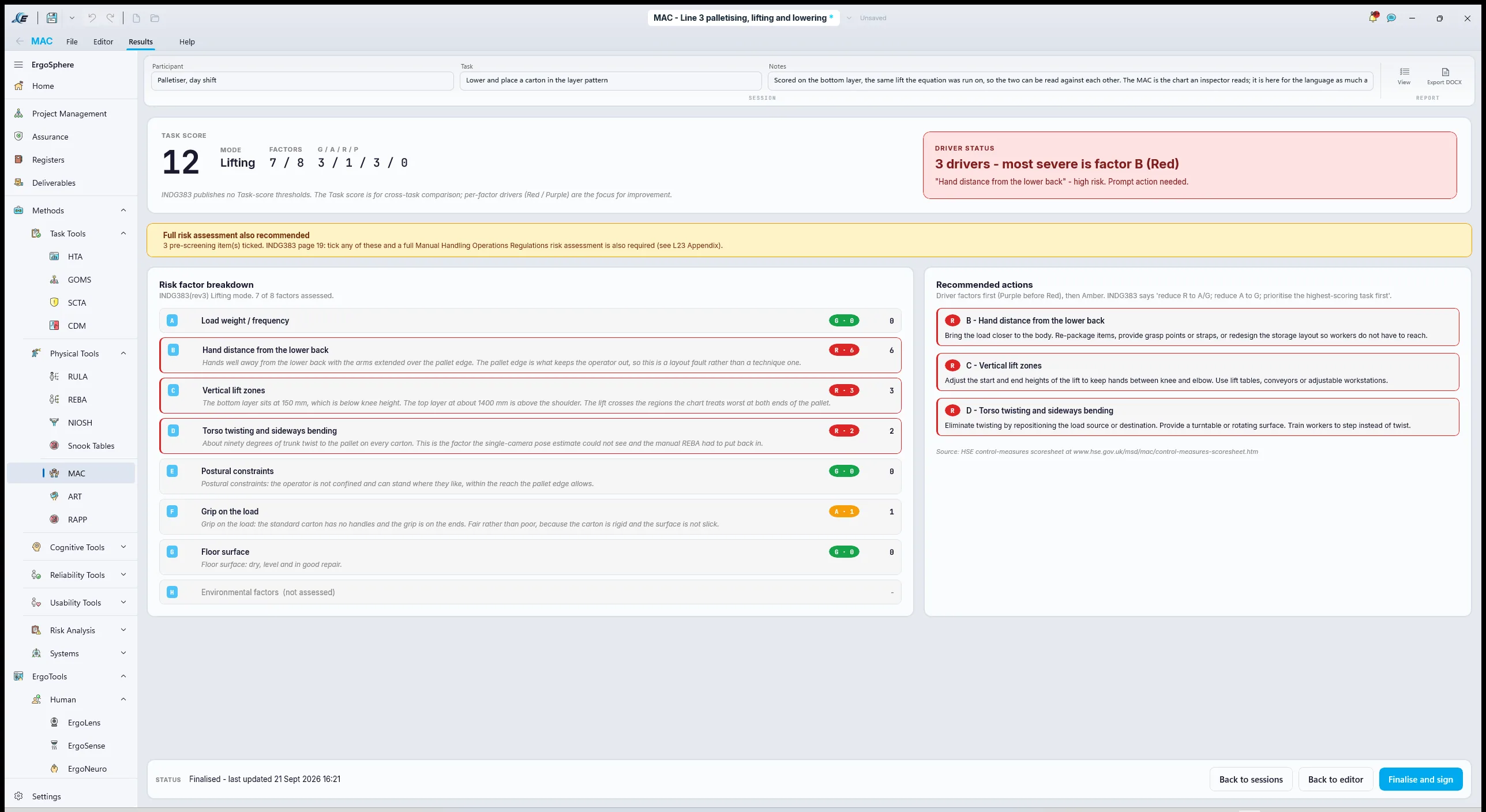
In ErgoSphere the MAC editor asks for the operation type first, Lifting / lowering, eight factors, and the pre-assessment checklist that decides whether the charts are enough or a full risk assessment is required on top. Three of its fifteen items are true here, each traceable to something already on the record: the carton travels from 150 mm to about 1400 mm, the rate is imposed by the process, and the task has a history of manual handling incidents. The results page then carries a banner saying a full Manual Handling Operations Regulations risk assessment is also required, and names how many items were ticked. Then each factor, with the chart's own wording: load weight and frequency read off the graph, hand distance from the lower back, vertical lift zones, torso twisting and sideways bending, postural constraints, grip on the load, floor surface, environmental factors. The results page gives the Task score, the band strip as G / A / R / P, the drivers, and a sentence the Coordinator read twice: INDG383 publishes no Task-score thresholds. The Task score is for cross-task comparison; per-factor drivers, Red and Purple, are the focus for improvement.
| Factor | Observed, bottom layer | Band | Agrees with |
|---|---|---|---|
| A | 12 kg at about 4 per minute, read off the chart | Green | Nothing. This is the disagreement, and it is the useful part |
| B | Hands away from the lower back, arms extended across the pallet edge | Red | The horizontal multiplier |
| C | Placement below knee height | Red | The vertical multiplier |
| D | Torso twisted and bent at the same time | Red | REBA's trunk score and the asymmetry multiplier |
| E | Not confined: the operator can stand where they like, within the reach the pallet edge allows | Green | Not in the equation at all |
| F | No handles, carton gripped at its ends, but rigid and not slick | Amber | The coupling multiplier |
| G | Dry, level, sealed concrete | Green | |
| H | Nothing ticked: not hot, not cold, no draught, no lighting problem | Not rated | The tool refuses to score a factor nobody assessed. Seven of eight factors are rated |
| Task score | the rated factors, added | 12 | Drivers B, C and D. No threshold exists to compare it to |
How to run the MAC charts
- Choose the operation the charts cover. Lifting, carrying or team handling, and only one per assessment.Operation type: Lifting / lowering, Carrying, or Team handling.
- Do the pre-check. The charts are a screen; some tasks need a full assessment as well, and the checklist says which.The Pre-assessment checklist card, and its "Full risk assessment also recommended" line.
- Read the weight and frequency off the graph, do not calculate it. The chart's bands are coarse on purpose.Factor A, the load weight / frequency chart, with the observed rate.
- Walk the remaining factors in order, at the worst moment. The bottom layer for this task. Each factor gets its colour and its reason.Factors B to H, each with the band picked from the chart's own descriptions.
- Read the reds, not the total. The regulator publishes no threshold for the task score. The red factors are the findings, and each is a control.Results: the G / A / R / P strip, the Risk factor breakdown and the drivers list; the Task score is for comparing this task with another.
- Compare with the equation. Where the two agree, the driver is named twice. Where they disagree, ask why, and write the answer down.The MAC session notes cite the NIOSH session and the three factors they agree on.
Interpret the results
Plan 5: do 5.1, 5.2, 5.3 in order. Return to 3 if any result raises a question the chosen methods cannot answer.
5.1Reading a REBA score
PracticeReading the result
A REBA score is read for its band and then for its source. Nine is high risk, and the band's action is investigate and implement change, not monitor and review. Then look at where the nine came from: Group A at 8 is the trunk, and the trunk score is flexion plus twist. Group B at 2 is unremarkable. That split tells the Coordinator which end of the body the control has to serve, and it says something about the two injury reports that the reports themselves did not: an experienced operator with four years on the station and a relief operator in their third week were doing the same thing with the same trunk, and the task was the constant. Technique, which is what both reports had blamed, is Group B and a little of Group A. It is not the nine.
And read what the photograph got right and wrong. The lens under-read the posture by exactly the factor it said it could not see. A screening instrument that is wrong in a known direction is a useful one, so long as the person using it knows the direction.
5.2Reading the Lifting Index, and the question from 1.2
PracticeReading the result
Is the task within capacity? No. A Lifting Index of 3.88 on the bottom layer and 3.4 on the top is in the band where most of the working population is at risk, and the recommended limit for this lift as designed is about a quarter of the carton. That is the answer to the first half of the question, and it is the same answer for the experienced operator and the relief operator, which is why the second report looked like the first one.
Which factor? The multipliers answer it in order. The frequency multiplier at 0.43 was the largest single cut, and it was the one factor nobody had measured. The horizontal reach, 0.56, is next, and it is a property of the pallet edge and the conveyor's position. The twist and the height each took about a fifth. The weight took nothing; it is the numerator. So the answer to the Production Manager is not "the cartons are too heavy". It is: at this rate, from this height, across this reach and through this turn, the acceptable carton would weigh about 3 kg. Yours weigh 12.
Now the harder reading. The frequency is the line's, not the operator's; the ErgoTempo session showed the operator waiting forty-one percent of the time. A control that changes the rate is a production decision, and the assessment cannot make it. What the assessment can do is say what each control would do to the index, and that is what 7.3 is for. The reach, the height and the twist are all engineering: a lift table brings the placement to the rollers' height for every layer and lets the operator stand close; turning the conveyor discharge to face the pallet removes the twist. Those two controls, priced from a catalogue, move three of the four multipliers, and the retest will say by how much.
5.3Reading the charts against the equation
PracticeReading the result
The charts are read for their red factors, and the task score is left alone, because the regulator that wrote them says there is no threshold to read it against. Three reds: hand distance, vertical zone, and twisting with bending. Those are the horizontal, vertical and asymmetry multipliers of the equation, named on a different list by a different author. The weight and frequency factor came out green, because the chart's bands are coarse and 12 kg at four a minute sits comfortably inside one of them; the equation, which is continuous, put the same fact at 0.43, the steepest cut in the whole calculation. That is the sharpest disagreement between the two instruments on this task, and it is worth more than either of them agreeing: the chart an inspector reads would have passed the one factor that turned out to drive the risk. It is a difference in resolution rather than in finding, and the session note says so. The eighth factor, the environmental one, is the other thing to notice on that screen. Nothing about the hall is wrong, so nothing was ticked, and the tool reports the factor not rated rather than green. Seven of eight factors are assessed. A green there would have been a measurement nobody took.
The number everyone knew was the one that did not matter
Both injury reports recorded the carton's weight. Neither recorded the height of the placement, the reach across the pallet, the turn, or how many times a minute it happened. The assessment measured those four and found that they, and not the weight, had cut the acceptable load to a quarter of the carton. The Production Manager's sentence was true. The station made it irrelevant. When the finding was presented that way, as the weight the station would accept rather than the weight the operator was lifting, the lift table was approved in the same meeting.
Write the user requirements
Plan 6: do 6.1 for every finding from 5 that needs a control, in the order of the hierarchy of control; then 6.2 across the set; then 6.3.
6.1From multiplier to requirement
PracticeA WHS person calls these controls, and the Code of Practice orders them: eliminate, then engineer, then administer, then protect. A requirement is the same thing written so a fitter can build it and a Coordinator can check it: who, shall, what, under which condition, to what criterion, verified how, with the analysis row as its source. Each of the reds and the big multipliers becomes one. The rate, which the assessment cannot fix, becomes an issue with an owner rather than a requirement nobody can meet. And the retest becomes a requirement of its own, because a control that is installed and never re-measured is a hope.
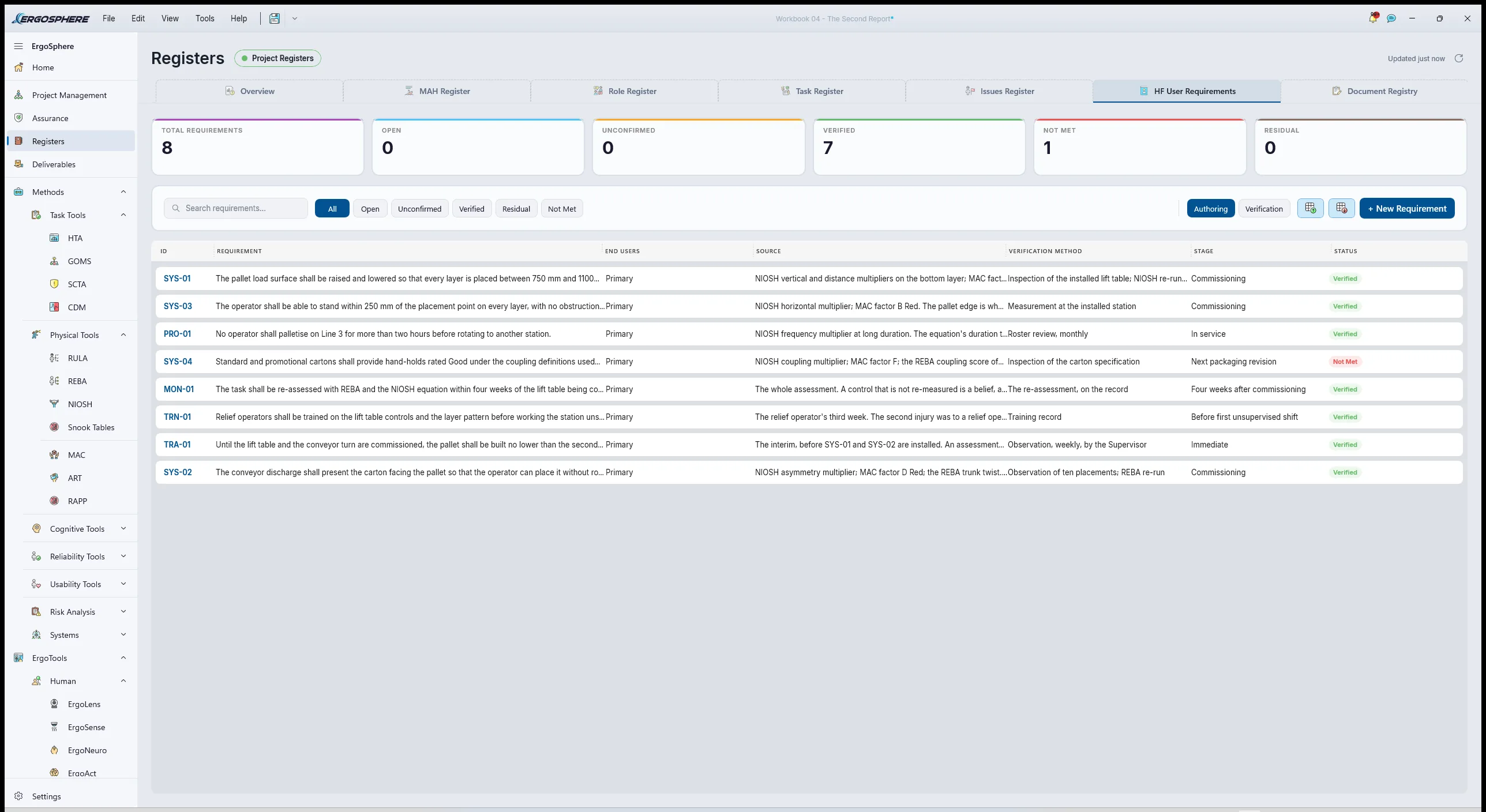
| ID | Source | Requirement | Verified by | Closed out as |
|---|---|---|---|---|
| SYS-01 | NIOSH vertical and distance multipliers on the bottom layer; MAC factor C Red; the REBA trunk flexion score | The pallet load surface shall be raised and lowered so that every layer is placed between 750 mm and 1100 mm above the floor. | Inspection of the installed lift table; NIOSH re-run at the first and seventh layer | Verified |
| SYS-02 | NIOSH asymmetry multiplier; MAC factor D Red; the REBA trunk twist | The conveyor discharge shall present the carton facing the pallet so that the operator can place it without rotating the trunk. | Observation of ten placements; REBA re-run | Verified |
| SYS-03 | NIOSH horizontal multiplier; MAC factor B Red | The operator shall be able to stand within 250 mm of the placement point on every layer, with no obstruction at foot level. | Measurement at the installed station | Verified |
| SYS-04 | NIOSH coupling multiplier; MAC factor F; the REBA coupling score of Fair | Standard and promotional cartons shall provide hand-holds rated Good under the coupling definitions used by the assessment. | Inspection of the carton specification | Not Met |
| PRO-01 | NIOSH frequency multiplier at long duration | No operator shall palletise on Line 3 for more than two hours before rotating to another station. | Roster review, monthly | Verified |
| TRA-01 | The interim, before SYS-01 and SYS-02 are installed | Until the lift table and the conveyor turn are commissioned, the pallet shall be built no lower than the second layer, with the bottom layer pre-placed at bench height. | Observation, weekly, by the Supervisor | Verified, then superseded |
| TRN-01 | The relief operator's third week | Relief operators shall be trained on the lift table controls and the layer pattern before working the station unsupervised. | Training record | Verified |
| MON-01 | The whole assessment | The task shall be re-assessed with REBA and the NIOSH equation within four weeks of the lift table being commissioned. | The re-assessment, on the record | Verified |
Why the rate is an issue and not a requirement
The frequency multiplier was the largest, and the frequency is set by the line, which is set by the contract. A requirement that says "the line shall run at two cartons a minute" cannot be met by anyone the Coordinator can write to, and a requirement nobody can meet is filed and forgotten. So the rate went into the Issues Register instead, with the Production Manager as owner, the residual Lifting Index from the retest as its consequence, and a status of Transferred once it was on the production agenda. The register does not hide it. It says whose it is.
6.2Keeping the set honest
PracticeEvery requirement can be failed. Every one traces back to a multiplier, a chart factor or a REBA element, and forward to a way of checking it and a person who checks. None says "safe" or "appropriate". SYS-04 is written knowing the carton is the customer's and will probably come back Not Met, with the reason recorded; it is not deleted for that. And the set is one set, in one register, in the hierarchy's order: the three engineering controls first, the administrative ones after, and no PPE at all, because there is none that lifts a carton.
6.3Into the register
In ErgoSphereThe HF User Requirements Register holds them. Each is entered with New Requirement and fixed at creation into a requirement group: System, Procedure, Training, Transition or Monitoring, which is the prefix each identifier carries. Then the end-user groups it protects, the Palletiser as primary and relief operators as secondary; the verification method and stage, written as a sentence; an owner, who is Maintenance for the system requirements and the Supervisor for the rest; and a status that starts at Open.
The register carries no clause pointer. It carries a source narrative, a sentence like "NIOSH bottom layer, vertical and distance multipliers; MAC factor C Red", written for the inspector who wants to trace the requirement to the measurement without opening the session. The standard's side of the trace is closed at stage 7 in the Requirements workspace.
Close out
Plan 7: do 7.1 for every finding; then 7.2 for every screened clause; then 7.3 once the controls are in; then 7.4.
7.1Findings into the Issues Register
In ErgoSphereThe two injury reports were already in the register from 1.3. The analysis added the rest with New Issue: the bottom-layer placement height, the trunk twist at the discharge, the reach across the pallet edge, the carton coupling, the line rate, and the pallet jack pull that was left at the boundary. The physical tools do not raise issues themselves, so each is entered with its source narrative naming the session it came from, the REBA at 4.3, the NIOSH at 4.5, the MAC at 4.6, and linked to the requirement it generated. Each carries a severity, an Area, an owner who can actually close it, a target date, the current control, which is the toolbox talk, and the proposed control.
Status is more than open and closed, and on this job it needed to be. The rate issue went to Transferred once the Production Manager took it onto the production agenda. The carton coupling issue went to Transferred as well, to the customer's packaging specification, with the note that a Not Met is expected. The register never folds Transferred into a closed count, because a risk somebody else now owns has not gone away.
7.2Closing the loop on the standard
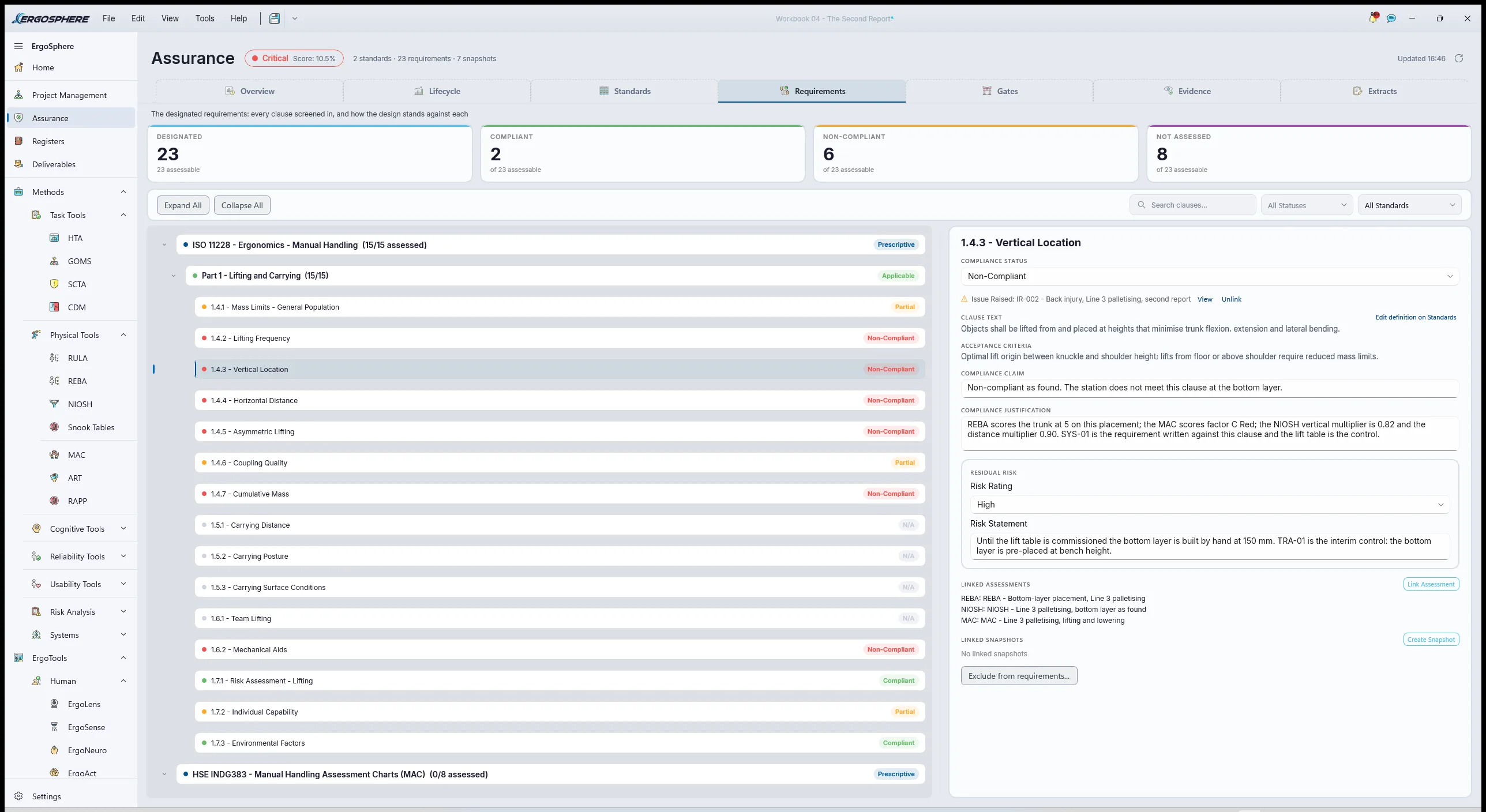
In ErgoSphereThe Part 1 clauses screened in at stage 2 have been waiting in the Requirements workspace. Link Assessment attaches the finalised REBA, the NIOSH sessions and the MAC session to the clauses they answer, the HTA to the task description clause, and the compliance status moves from Not Assessed. At the first pass, before the controls, the lifting clauses are Non-Compliant, with the height and twist issues raised against them and a residual risk rating that says so, and the professional judgement statement says why in one sentence: the recommended limit for the lift as designed is about a quarter of the load. That is an honest first pass, and the workspace is built to hold it. Nothing is marked Not Applicable here for a reason of scope; exclusions belong to screening, and Parts 2 and 3 were excluded there. The four carrying and team-handling clauses inside Part 1 are answered Not Applicable, because Part 1 came in as a whole and those clauses sit inside it, and the task has no carry and no second person.
One number on the header cards is worth explaining before a reader trips over it. The workspace counts 23 designated clauses and reports eight Not Assessed. The fifteen assessed ones are ISO 11228 Part 1, and they are all answered. The eight are HSE INDG383's, and they are deliberately left alone: INDG383 is on this project's Standards Register as the method the MAC assessment comes from, not as a standard the station is judged against. Answering its factors as compliance clauses would re-enter the MAC session's own results in a second place and invite them to drift apart. The governing standard is ISO 11228-1 and the register says so. The assurance score in the corner is low for the same reason, and it is supposed to be at this point in the job: it is a count of answered clauses against a scope that has only just been set.
7.3The retest, and the argument
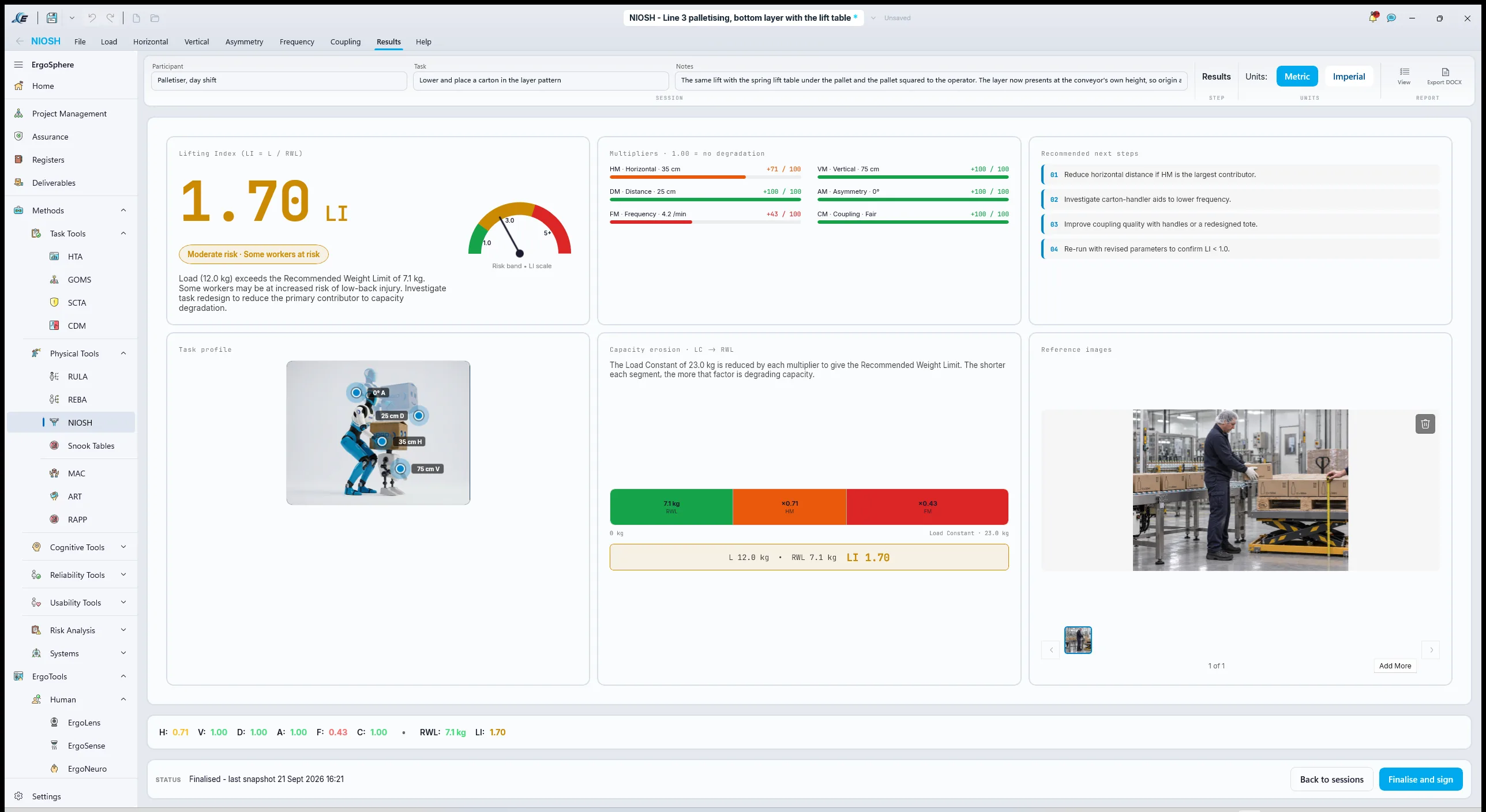
PracticeIn ErgoSphereFive weeks later the lift table was in and the conveyor discharge had been turned to face it. The Coordinator went back with the tape and the phone, and MON-01 was met the way it was written: a REBA and a NIOSH re-run on the same lift at the same rate. The placement now happens at the rollers' height on every layer, with the operator standing close, and with no turn. Horizontal 350 mm, vertical origin and destination both at 750 mm, asymmetry zero, frequency still four a minute for a long duration, coupling still fair.
| Measure | Before | After the controls | With rotation | What moved |
|---|---|---|---|---|
| REBA, worst placement | 10 | 5 | 5 | High risk to medium. The trunk score went from five to two and the legs from two to one; the load, the coupling and the activity are unchanged, because no control touched them |
| Recommended weight limit | 3.1 kg | 7.1 kg | 11.4 kg | Height, distance and asymmetry multipliers all at 1.00. Then duration from long to moderate |
| Lifting Index | 3.9 | 1.7 | 1.0 | High risk to Moderate risk, then to the boundary of Low |
| Largest remaining multiplierThe frequency multiplier, in all three columns | 0.43 | 0.43 | 0.70 | The rate. Still the line's, still Transferred |
The engineering controls took the index from 3.9 to 1.7 and did not touch the frequency multiplier, because they could not. The two-hour rotation in PRO-01 moved the duration category and took it to 1.0, on the line between some workers at risk and nominal demand. That is where it stays until the rate changes, and the register says whose decision that is. Both retests are finalised, and the Requirements workspace is revisited: the lifting clauses move to Partially Compliant, with the residual index stated and the rate issue still open against them.
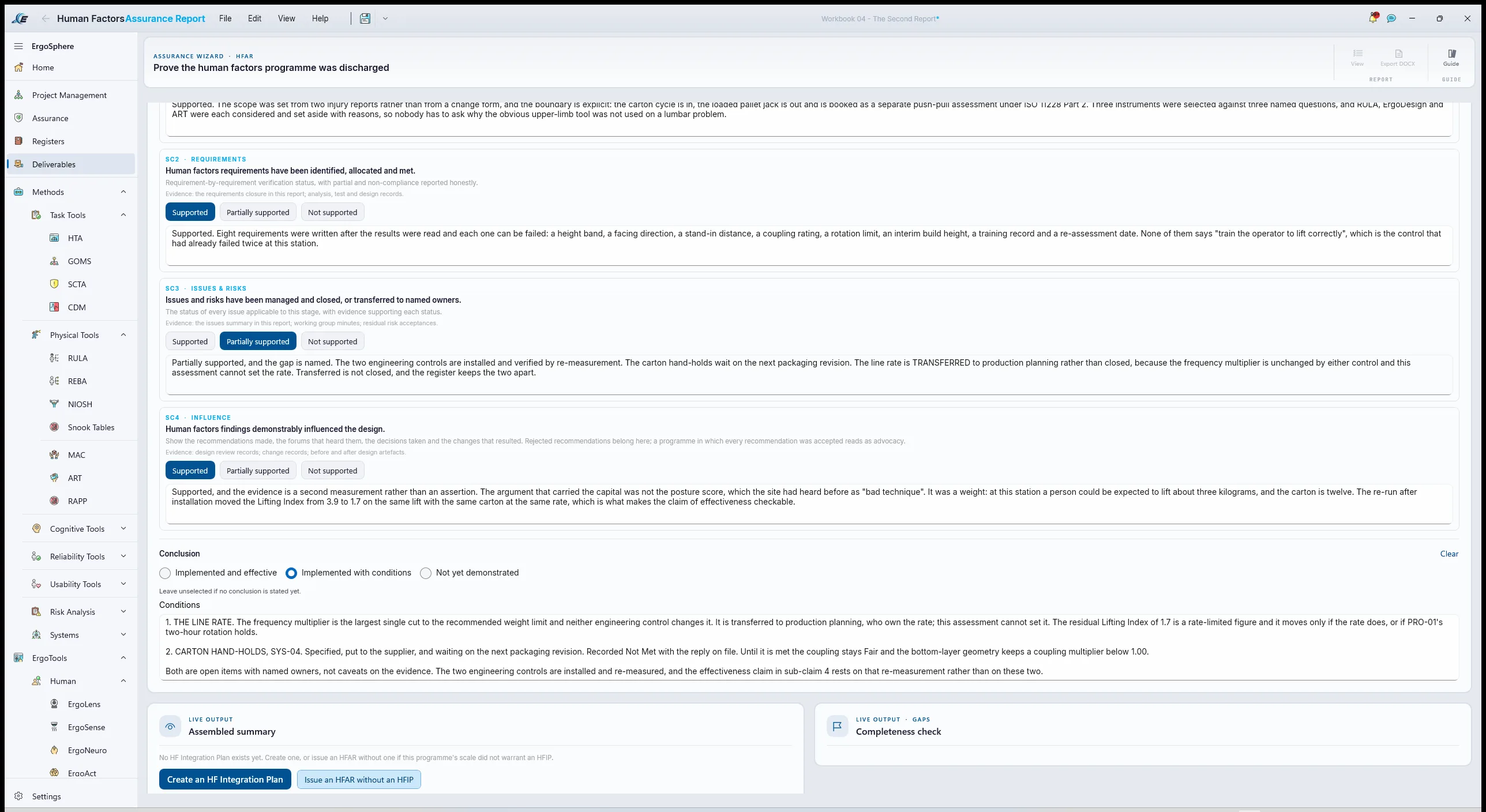
The close-out wizard then builds the assurance report. Each requirement is closed with its evidence: SYS-01 to SYS-03 Verified by the retest, SYS-04 Not Met with the customer's reply on file, PRO-01 and TRN-01 Verified by the roster and the training record, TRA-01 closed as superseded, MON-01 Verified by the retest itself. Every issue is traced to its requirement, and the two injury reports from 1.3 are traced to all of them. Then the four sub-claims, each with a position and a reason: that the programme delivered was the one the risk required, Supported, because the scope came from two injury reports and three instruments were chosen against three named questions; that the requirements were identified and allocated, Supported, because eight were written after the results were read and every one of them can be failed; that issues were managed and closed or transferred, Partially Supported, because the rate is transferred rather than closed and the hand-holds wait on the next packaging revision; that the findings demonstrably influenced the design, Supported, because the lift table and the conveyor turn are the findings, built, and the re-run measures them. The verdict the tool offers for this, and the one selected, is Implemented with conditions, and the conditions are the two Transferred items and the residual index they leave. The completeness check lists them by kind, so issuing with them is a recorded act and not an omission.
7.4Issued, not emailed
In ErgoSphereThe REBA, NIOSH and MAC reports and the assurance summary are marked ready in Deliverables, and Compose Package puts them into one file, hash-sealed, with a manifest, issued as Revision A to the Production Manager and filed against the two incident numbers. The Production Manager opens it in the free Viewer and finds the task tree, the observed times, the three assessments and the argument, and can turn the multipliers tile around without asking for a spreadsheet. The one comment that came back was anchored to the NIOSH retest, and it was the right one: the residual 1.0 depends on a rotation the roster does not yet enforce. Revision B added the roster review to MON-01's evidence, and the comment was resolved against the revision that answered it. The two injury reports were closed in the register on the same day, with their resolution notes pointing at the package.
Common mistakes
What a less experienced WHS person would have done on this job, and what to do instead.
The mistake
File the second report under technique, because the first one was, and schedule the toolbox talk again.
Instead
Two reports from one station in six weeks is a finding about the station. Open the register with the reports as the first two issues and go and look at the task, not the people.
The mistake
Take the phone photo's REBA score as the assessment and put it in the report.
Instead
Read what the tool says about the trunk dial: rotation cannot be measured from one 2D view. A lens score is the reason to assess. Confirm it by hand, at the station, on the worst moment.
The mistake
Run RULA, because it is the one from the training course and the one that runs free in the browser.
Instead
Match the tool to the body part at risk. RULA is an upper-limb tool. A stooped, twisted floor-level lift is REBA's job, and the road not taken goes in the record.
The mistake
Take the frequency from the Supervisor and put "approx. 2 per minute" in the equation.
Instead
Count it. Twenty minutes beside the station gave four a minute, and the frequency multiplier turned out to be the largest single cut in the equation. The most important number is the one nobody has measured.
The mistake
Report the MAC task score as if it were a risk rating, and compare it to a threshold from a training slide.
Instead
Read the reds. The regulator publishes no task-score threshold, and the tool says so on the results page. Three red factors are three controls; the total is for comparing one task with another.
The mistake
Recommend a lighter carton, because the weight is the number in both reports.
Instead
Read the multipliers before the index. The weight is the numerator; the station is the denominator. Height, reach and twist were the reds, and a lift table and a conveyor turn fixed all three for less than a carton redesign.
The mistake
Close the issues the day the lift table is installed.
Instead
Retest. Same lift, same rate, same tools, five weeks later. The index came down to 1.7, then to 1.0 with rotation, and the residual is on the record with the rate issue and its owner. A control without a retest is a hope.
Do it yourself
The project this example was built in is issued below as an ErgoSphere project file. The Revision A Viewer deliverable follows. Open the deliverable in the free Viewer to walk the task tree, read the observed times, and turn the multipliers tile around. Open the project file in ErgoSphere to re-run the equation with your own carton, your own heights and your own rate, and see which multiplier your station spends. Both are built for the scenario and carry no client data.
- workbook-04-second-report.ergsphr
- workbook-04-second-report-revA.ergview · pending