
Medical Device HF
From the use specification to the HFE/UE report, in the same project file as the rest of the Human Factors programme. One thread from user need to validation, aligned with IEC 62366-1, ISO 14971 and the FDA's 2026 Human Factors guidance.
- IEC 62366-1 · Ed 1.0
- ISO 14971:2019
- FDA HFE guidance, August 2026
- FDA HF content guidance, May 2026
- 510(k) · De Novo · PMA · HDE
-
Two ways in
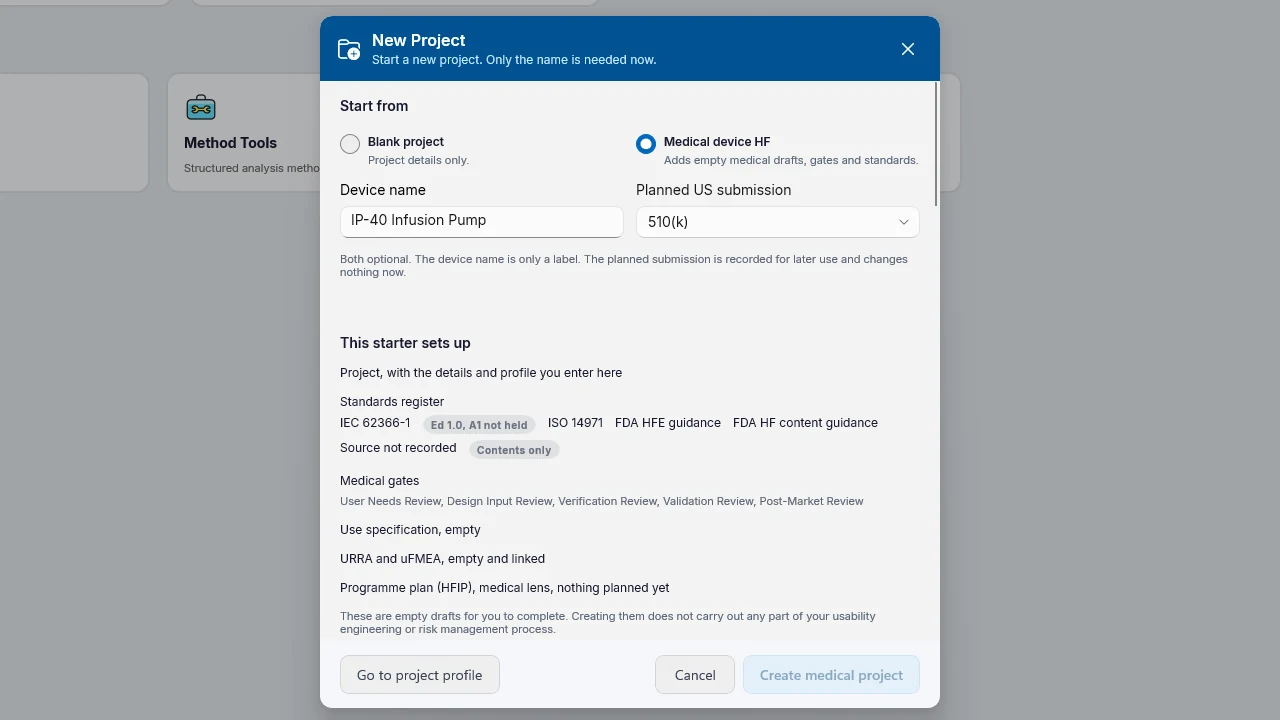
Blank project, or Medical device HF. The medical starter adds empty drafts, gates and standards to a new project; a blank project stays blank.
-
The device and the route
A device name and the planned US submission: 510(k), De Novo, PMA, HDE or not yet known. Both optional. The submission is recorded for later and changes nothing now.
-
Editions stated, never inflated
IEC 62366-1 goes into the standards register as Ed 1.0, with Amendment 1 not held, and AAMI HE75 by its contents only. The register says what was read.
-
Five gates
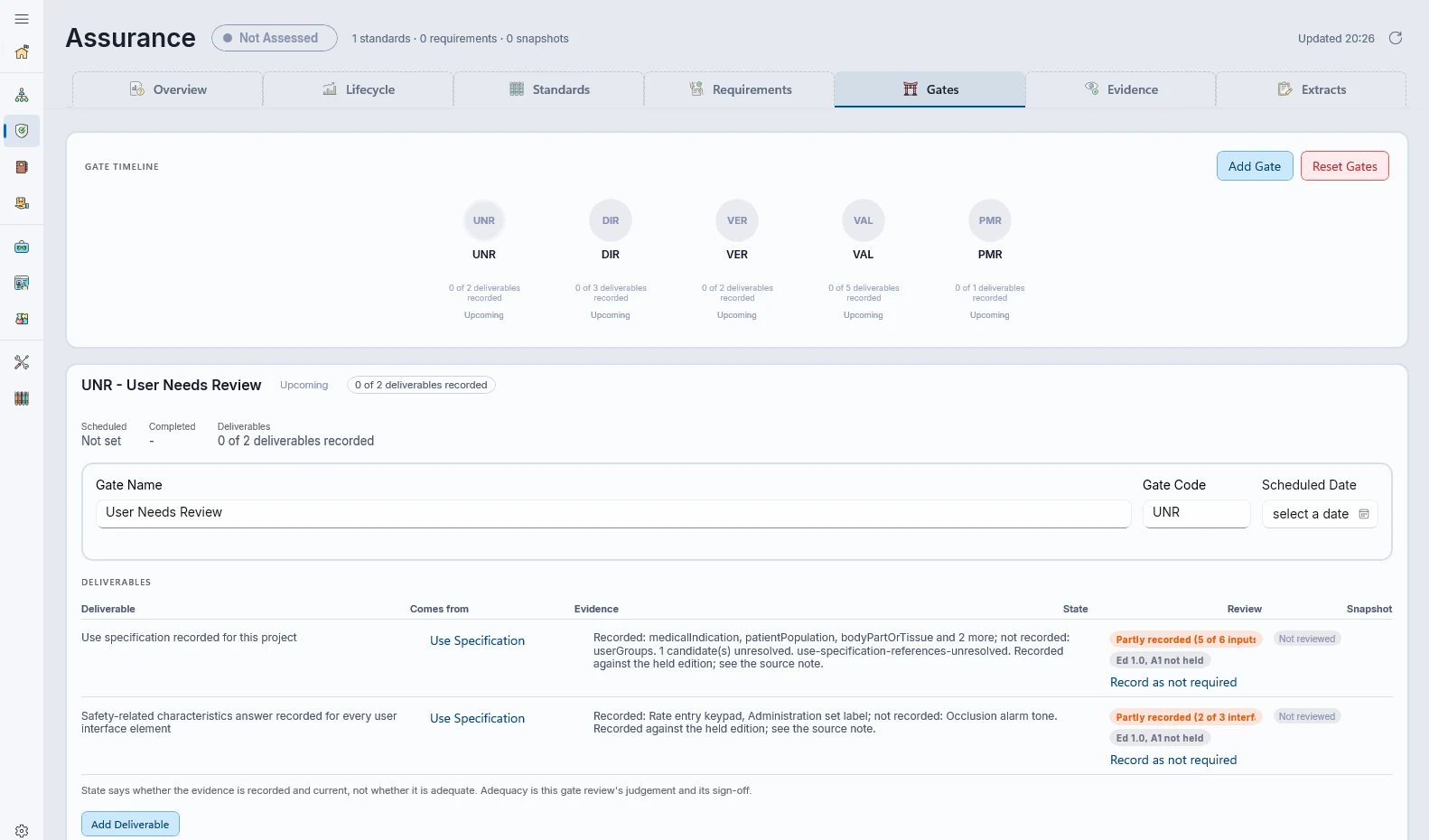
User Needs, Design Input, Verification, Validation and Post-Market Review, laid into the Assurance lifecycle with the deliverables each one waits for.
-
Linked from the first step
A use specification, a URRA and a uFMEA that already point at each other, and a Human Factors integration plan with a medical lens, nothing planned until you plan it.
-
Empty, and says so
These are empty drafts. Creating them carries out no part of the usability engineering or risk management process, and the dialogue says so before you press Create.
One Thread, Need to Validation.
A medical usability engineering file is a chain. A user need becomes a requirement on the interface; the requirement names the tasks that matter; a task carries the use errors that could hurt someone; each use error carries its risk controls; and the controls that matter most are proven in validation. In most programmes that chain lives in five documents that do not know about each other. Here it is one set of records in one file, and a break in it is flagged where it happens.
ISO 14971 asks for traceability and, in clause 4.5, prescribes no columns. So the trace matrix exports in the shape your client's quality system already uses, mapped per client and kept.
img/screenshots/web/medhf-use-specification.webp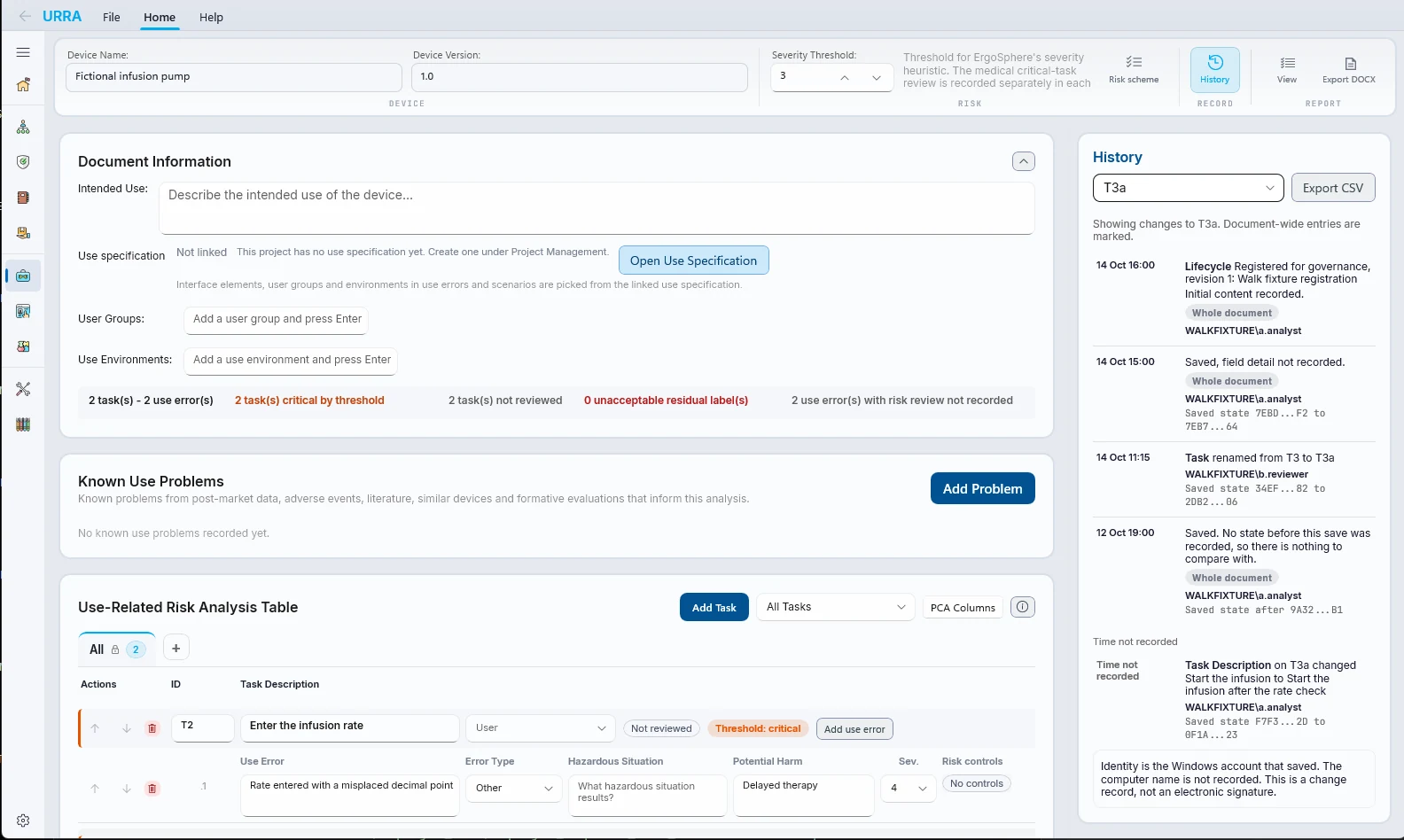
img/screenshots/web/medhf-validation-protocol.webpimg/screenshots/web/medhf-trace-matrix.webpOne Step. Five Gates.
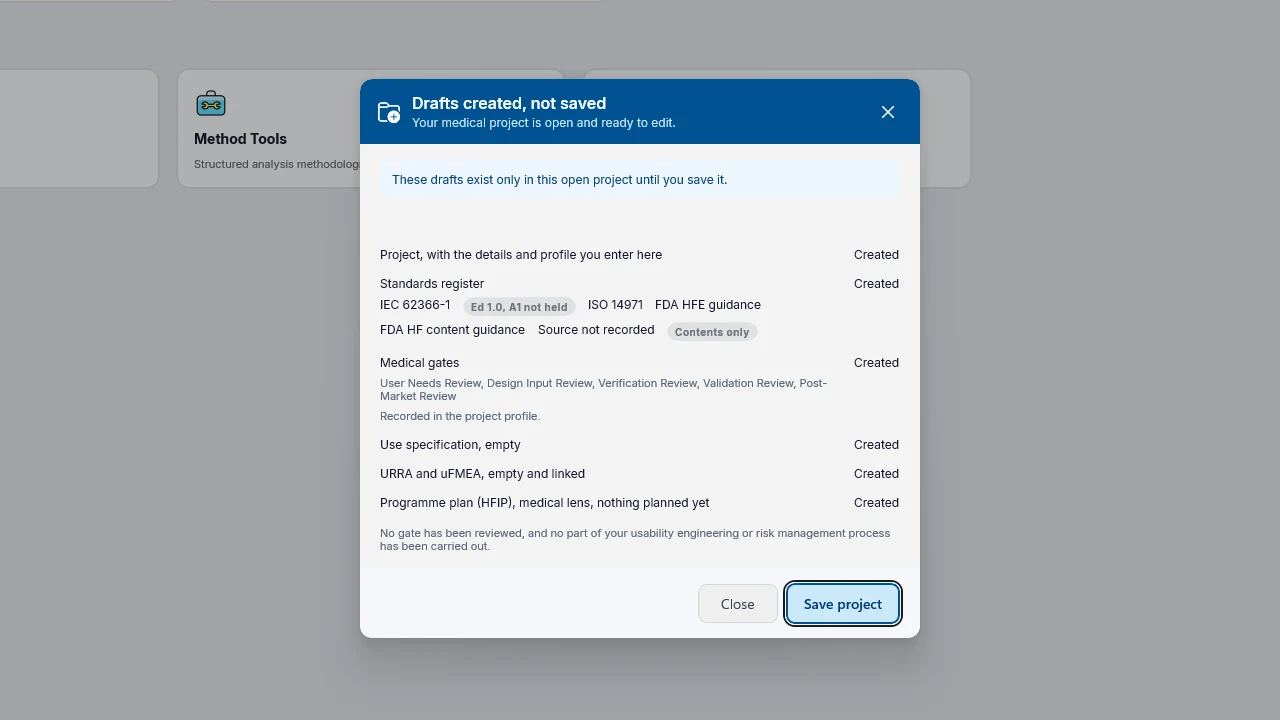
The Medical device HF starter creates the project's drafts in one step and says exactly what it made: the standards register, the medical gates, an empty use specification, a URRA and uFMEA linked to each other, and a programme plan with a medical lens. Nothing is saved until you save it, and nothing has been reviewed until somebody reviews it.
The gates sit in the Assurance lifecycle like any other. Each lists the deliverables it waits for and where each comes from, and the evidence state reads Recorded, Partly recorded with a count, or Not recorded. Never Met, never Pass. The state says whether the evidence is recorded and current; whether it is adequate is the gate review's judgement, and its sign-off.
- Gates
- UNR · User Needs
- DIR · Design Input
- VER · Verification
- VAL · Validation
- PMR · Post-Market
- Evidence
- Recorded
- Partly recorded (n of m)
- Not recorded
- never Met or Pass
Find It While It Is Cheap to Fix.
Formative work is where a design gets better, and the tool is built for rounds. Each round has a plan, pseudonymised participants by user group, and tasks drawn straight from the URRA. A participant by task grid records whether the task was completed and, independently, what was seen on the way: a use error, a close call, a difficulty, help needed, or none of these.
Every finding carries a design response and a review state. Send it to the URRA as a known use problem or as a new use error, and the risk analysis learns what the round found. Rounds compare side by side on the Study board and report to Word.
The tool says what formative evidence is for: it supports design exploration, and it does not validate a final design.
- Per task
- Completed
- Use error
- Close call
- Difficulty
- Needed help
- None seen
- Then
- Send to URRA
- Study board
- Word report
Standards. IEC 62366-1 clauses 5.7.1, 5.7.2 and 5.8, and section 6.4.3 of the FDA's August 2026 guidance.
img/screenshots/web/medhf-formative.webpProtocol to Root Cause, Without a Pass Mark.
HF Validation drafts the protocol from the work already in the file: the critical tasks, and the use scenarios the URRA selected for validation with their rationale. It suggests a participant target from the FDA's recommendation, which stays a recommendation; the analyst accepts it or records the departure and the reason.
There is no success rate, and that is by design. Validation of a medical device interface is not a percentage of tasks passed. The results count distinct participants against each kind of use problem, by user population and scenario, and every issue goes to a root cause before the residual risk is reviewed.
Locked, versioned, compared
Test design, documentation and training conditions with their decay interval, scenarios and knowledge tasks, and the four use-problem procedures. Lock protocol fixes a hashed baseline; a change makes a new version with its reason, and versions compare side by side. The lock is an ErgoSphere integrity control, and it is declared as one.
Participants, not percentages
Distinct participants per kind of use problem, by population and scenario. Every issue takes a root cause, interface, labelling, training, test artefact or other, read as explained or undetermined. A cause nobody could find is recorded as undetermined, not guessed.
Before and now, with the reasoning
Each issue's residual risk is reviewed before and after, with a rationale, and Update URRA carries the decision back to the risk analysis with a durable receipt. The validation and the risk file cannot quietly disagree.
img/screenshots/web/medhf-validation-results.webpimg/screenshots/web/medhf-ip40-library.webpThe Category, Then the Report.
The FDA's May 2026 guidance on the content of Human Factors information in marketing submissions sorts a submission into one of three categories through a figure with four decision points. An assurance wizard beside HF-ANR walks that figure, decision points A to D, to Category 1, 2 or 3, and assembles the HFE/UE report to the guidance's own section structure for that category.
The category states the information the guidance recommends, not FDA acceptance and not device safety. An incomplete report can be read and exported as a clearly labelled draft, and cannot be marked ready, issued or packaged until it is whole. A combination product is refused a category rather than given a wrong one.
- Export
- HFE/UE report
- Trace matrix CSV + manifest
- Excel workbook
- ReqIF
- Use Specification
- Import
- Client hazard list, CSV
- preview, then all or nothing
img/screenshots/web/medhf-submission-category.webpEvery change, in plain words
A History panel on the URRA, uFMEA, HF Validation and Use Specification, and on ErgoBow, SCTA and the HTA, lists each saved change as before and after, filters to one subject, carries the saved state's fingerprint and exports to CSV. It is a change record, and it says so: not an electronic signature.
Scenario to control, in the risk analysis
Each use error carries the client's hazard identifier, the interface elements involved, its hazard-related use scenarios as ordered steps with harms and severities, risk controls with implementation and effectiveness evidence kept apart, and whether it is included in validation, with the reason.
Draft, In review, Approved
The URRA and uFMEA move through a document lifecycle and keep step with each other through a planned, reviewable sync. A row imported into the uFMEA reads Scores not confirmed until someone confirms them.
Shall, Should, May, Informative.
Before a screen was drawn, the held sources were read into 939 requirement rows, each carrying its clause, its page in the PDF and in print, its operative words and its force: shall, should, may or informative. Each extraction was verified independently, and where the held text says nothing, the row says Not in held text rather than filling the gap.
That is why the starter writes Ed 1.0, A1 not held beside IEC 62366-1, and why an FDA recommendation is never promoted to a requirement anywhere in the application. The tools then went into the dossier programme like every other method, with 1,932 test methods standing behind the medical work on 12 November 2026.
IEC 62366-1
Ed 1.0 (2015). Use specification, safety-related characteristics, hazard-related use scenarios, selection for summative evaluation, formative and summative evaluation.
HeldEd 1.0 · Amendment 1 (2020) not held, and said so in the registerApplying HF and Usability Engineering to Medical Devices
The revision issued 3 August 2026. Formative evaluation and the Human Factors validation test.
Read forsections 6.4.3, 8 and 8.1Content of HF Information in Marketing Submissions
Final, 29 May 2026. The submission categories and the HFE/UE report structure each category calls for.
Read forFigure 1, decision points A to D · section V report structureISO 14971 and ISO/TR 24971
EN ISO 14971:2019 and ISO/TR 24971:2020. Traceability between hazards, risk controls and their verification.
Read forclause 4.5, which asks for traceability and prescribes no columnsWhere the boundary is. ErgoSphere prepares and analyses Human Factors records for your quality system. It does not approve a device, decide a submission, guarantee clearance or provide 21 CFR Part 11 signatures; identity on a record is the Windows account that saved it, and client reports leave account names out. The FDA's recommendations stay recommendations wherever they are quoted, and no catalogue entry claims recognition or conformity.
The Healthcare Pack, Or Everything.
The Healthcare pack carries the Medical Device HF module with the methods a usability engineering file leans on: HTA for the tasks, URRA and uFMEA for use-related risk, SUS and Nielsen's heuristics for the formative rounds, and Deliverables to issue the report. Two picks from the rest of the catalogue come with it. Full carries the same module beside every other tool and module.
AUD, excluding GST. The Medical Device HF module is core, with Formative Evaluation and HF Validation. Two picks from the rest of the catalogue come with it.
- Monthly over 12 months$200
- Exit anytime$259
- 11 to 25 seats, yearly, each$1,900
The module also comes with Full, every tool and module, at $4,900.
Core in the Healthcare pack
- Formative Evaluation
- HF Validation
- HTA
- URRA
- uFMEA
- SUS
- Nielsen
- Medical Device HF
- Deliverables
The two new method tools in cyan tiles, the methods beside them, modules last. The Medical Device HF module brings the use specification, the medical starter and gates, the submission category, the HFE/UE report, the trace matrix export, History, URRA traceability and uFMEA sync.
Need to take this to a manager? The business case, with the arithmetic already done. Buying for a team? The seat bands.
Records, Not Verdicts.
A use specification, a risk analysis that knows what the formative rounds found, a validation that counts participants rather than passes, and a report that will not issue until it is whole. Read from the sources first, with the editions stated. Two of the 60 tools, and the module around them.